
Canada AI Immigration Tools 2025: Automated Services for Work Permits & PR Applications
November 8, 2025
AI Consulate Meaning (What People Usually Mean When They Say It)
December 27, 2025
You don’t have to wear a suit or speak five languages to get hit by AI diplomacy. If you travel, apply for a visa, watch the news, or just want fewer “international incident” alerts on your phone, this stuff lands in your lap and shapes everyday international relations.
AI diplomacy is when governments use artificial intelligence tools to talk, plan, warn, and react across borders. It can mean real-time translation in tense meetings, faster crisis response when things go sideways, and systems that flag fake posts before they start a panic. In 2025, this isn’t a sci-fi pitch, it’s daily work.
But here’s the weird part, the same tech that helps diplomats move fast can also pump out deepfakes and voice clones that look painfully real. Trust is the whole job in diplomacy, and AI makes trust easier to fake and harder to prove. You shouldn’t have to squint at every clip like you’re a body-language cop.
This guide keeps it practical. You’ll see what’s changing in 2025, what the main tools do, where they fail, and how bad info can spread. You’ll also get a clear way to think about AI amid diplomacy’s digital transformation, without needing a badge or a briefing room.
What AI diplomacy is, and why it matters to you
AI diplomacy is diplomats using artificial intelligence in the practice of diplomacy, the way you use it to read faster, write faster, and catch problems sooner. The only difference is their “group chat” can include sanctions, border closures, and a statement that moves markets. No pressure.
For you, it shows up as quicker travel help, faster alerts when a crisis hits, and better (not perfect) defenses against fake videos, disinformation, and rumor storms. It also raises a blunt question: when a message crosses borders in seconds, how do you know it’s real?

Where AI shows up in real diplomatic work
This is not robots doing treaties while humans go get snacks. It’s more like giving an exhausted team an extra set of eyes from artificial intelligence, plus a fast intern who never sleeps (and sometimes makes stuff up, so you still check it).
Here are concrete ways AI shows up in day-to-day diplomatic work:
- Translation and meeting note summaries: Real meetings move fast, and accents are real. AI tools can translate speech and turn messy notes into clean bullets. That saves hours and cuts “Wait, did they mean may or must?” moments. You still need humans to review, because one bad verb can spark a week of damage control.
- Scanning news and social posts for early warnings: Teams track local news, Telegram channels, and social feeds to spot trouble early. Machine learning helps sort the firehose, flagging spikes in hate speech, protest calls, or rumor waves. The goal is time. Even a 30-minute head start can matter when flights get canceled or crowds gather. Work on AI for strategic warning gets into the upsides and limits in plain terms, see Applying AI to Strategic Warning.
- Drafting briefs, talking points, and Q-and-A: Briefs are the diplomatic version of cramming before a final, except the final has cameras. AI can draft a first pass, pull key facts, and propose outlines. That frees humans to do the real work, picking what matters, what’s sensitive, and what should never be said out loud.
- Tracking aid and supplies during disasters: In a big crisis, the problem is rarely “no help exists.” It’s “help is stuck, misrouted, or duplicated.” AI can help match needs to shipments, spot bottlenecks, and update maps as roads close or ports reopen. Better tracking means fewer wasted trucks and fewer warehouses full of the wrong stuff.
- Consular support (answering common traveler questions): If you’ve ever searched “Do I need my passport to cross…?” at 2 a.m., you get it. AI chat systems can answer routine questions on visa steps, local rules, and what to do after a theft. That can cut wait times, so staff can focus on real emergencies, like arrests, missing persons, or evacuations.
- Spotting sanction evasion patterns: Sanctions are not just speeches. They’re lists, ships, bank wires, shell firms, and a lot of “Nothing to see here” energy. AI can look for odd trade routes, repeat middlemen, and patterns that suggest evasion through data analysis. It does not “solve” it, but it helps analysts find needles faster. Research groups talk about these practical uses in pieces like the Belfer Center’s AI-Powered Diplomacy.
The benefit across all of this is boring, and that’s good: less time on sorting and formatting, more time on judgment and decision-making. Also fewer missed signals, because humans are not built to read 200,000 posts before lunch.
Why this shift is happening now
Diplomacy used to move at the speed of flights and fax machines. Now it moves at the speed of a clip going viral, plus a politician reacting to it on live TV. This shift in diplomatic practice…
A few drivers are pushing AI into the room:
- Crises hit faster: An earthquake, a border clash, a sudden coup rumor, a hacked video. You don’t get a clean runway anymore. You get chaos, then a headline, then someone asks for a statement in 12 minutes.
- There’s more data than humans can read: Public posts, satellite images, shipping logs, economic stats, call center logs, leaked docs. Humans can sample. AI can triage.
- Online influence ops are constant: States and groups push fake stories, fake “locals,” and narratives to project soft power and real anger aimed in the wrong direction. If you wait to respond until it’s obvious, you’re late. If you respond too early, you can amplify a lie. Great choices, right?
- Pressure to move quicker while budgets stay tight: Many agencies face the same math you do at home. More work, same staff, same money. AI is a way to keep up, at least on the routine tasks. A real example of this “do more with data” push shows up in the Foreign Service Journal piece, Toward Data-Informed Multilateral Diplomacy.
Generative artificial intelligence changed the pace because it doesn’t just sort info, it writes. That means drafts appear in seconds, not days. It also means new security headaches: sensitive data in prompts, draft leaks, and models that can be tricked or copied. Faster output is nice. Faster mistakes are not.
What does not change: trust, relationships, and verification
Diplomacy runs on trust. Not “good vibes” trust, more like “I believe you won’t stab me with this comma” trust.
AI can help with prep and pattern spotting, but the core job stays human:
- You still need relationships. A hotline call works because two people built it over years.
- You still need careful language. Public words are tools, and sometimes weapons.
- You still need verification. You don’t act on a model’s guess, you confirm.
Here’s why the wording part is so touchy. Imagine a joint statement after a tense meeting:
- “We will support inspections” reads like a promise.
- “We may support inspections” reads like a dodge.
That one word changes how allies react, how markets read risk, and how the other side plans its next move. An AI draft might pick the wrong word because it sounds polite. Humans review because humans understand the hidden costs.
Think of AI as the assistant who preps your notes and hands you a clean draft. You still decide what you sign, what you send, and what you can stand behind when the clip hits the internet at 3 a.m.

What’s new in AI diplomacy in late 2025
Late 2025 feels like the moment artificial intelligence stops being “a neat pilot” and becomes “part of the job.” Not in a sci-fi way. In a paperwork, training, and daily workflow way.
Two big U.S. policy moves point the same direction as national AI strategies: more artificial intelligence in day-to-day diplomacy, plus more rules about where the strongest tech goes and how it gets used. You get speed, you also get new ways to mess up fast. So the theme is simple: move quicker, verify harder.
Inside the U.S. State Department’s 2026 Data and AI Strategy
On September 30, 2025, the State Department put out its 2026 Enterprise Data and AI Strategy. It reads like a plan to make artificial intelligence normal at work, not a side hobby for the one person who “likes tech.”
At a high level, the strategy has two main aims:
- Use data and AI to sharpen statecraft, so teams can respond to real problems faster.
- Speed up adoption inside the department, so tools do not sit unused.
If you want the source doc, it’s here: Department of State Enterprise Data and AI Strategy (September 2025 PDF).
The practical tools you keep hearing about: StateAI, StateChat, and agentic AI
The strategy calls out a few concrete tools and directions.
StateAI (AI.State) is pitched as a central resource hub. Think of it like the department’s “one front door” for AI tools, guides, and approved ways to use them. That matters because the fastest way to create chaos is letting every office invent its own AI rules on a Tuesday.
StateChat is framed as the department’s first generative AI chatbot for quick support. In plain terms, it’s there to help staff get answers and complete routine tasks faster. Not to replace diplomats, but to cut the drag from constant small asks.
Then there’s agentic AI, which is the big “late 2025” vibe shift. A chatbot answers. An agent does. The strategy points to agent-like systems that can support routine workflows such as:
- Paperwork and admin flows (the forms, the routing, the approvals)
- Crisis response support (helping teams sort info and track actions)
- Checks on programs and assistance (supporting oversight and review)
If your reaction is “cool, so the robot can file the forms,” yes, that’s the point. Diplomacy has a lot of high-stakes moments, and also a lot of low-glory work that eats your day.
Data.State and the push for shared datasets
The strategy also puts real weight on data plumbing. It points to Data.State as a platform for sharing data assets across the department, with a clear push to expand shared, mission-ready datasets.
You can see the State Department’s data work here: Data Informed Diplomacy at State.gov.
This matters because AI tools are only as good as the data they can use safely. No shared data means every team builds its own spreadsheet bunker. Shared data means you can actually reuse work, compare notes, and move faster without guessing.
Training plans: not “watch this video,” more like reps
The strategy does not pretend people will magically become great at AI because someone emailed a PDF.
It describes training plans that include:
- Classes built into education tracks
- Hands-on workshops for real use cases
- Simulated scenarios (practice runs that mimic real pressure)
That last one is underrated. In diplomacy, “practice” is often the only safe place to learn what an AI tool does when the facts are messy and the clock is loud.
Risk controls: not perfect safety, but real guardrails
The strategy also talks about basic controls to manage risk, establishing key elements of the governance of AI. Not “trust the model,” more like “trust, then verify, then verify again.”
The approach includes ideas like:
- Risk lists and registries (track known risks, do not act surprised later)
- Checks and testing before tools get used broadly
- A security posture that assumes systems get probed and pushed
No system makes AI “safe” in a magic way. But these controls signal a mindset shift: AI use is expected, and oversight is part of the package.
What this means for you (and for how diplomacy works)
This strategy is a bet that diplomats will use AI tools every day, not once a month when someone remembers a demo. It normalizes AI for drafting, sorting, and support tasks, while trying to keep guardrails in place.
The big change is cultural. AI becomes part of the standard kit, like secure email or a briefing template. That can raise quality and speed. It can also raise the cost of sloppy use. If your first draft is wrong and goes out faster, guess what, the mistake travels first-class.
The White House AI Action Plan and what it means for allies and rivals
On July 23, 2025, the White House released America’s AI Action Plan, with a long list of actions across innovation, infrastructure, and international leadership fueled by technological advancements.
If you translate the plan into normal-person language for diplomacy and security, it comes down to a few big moves in this geopolitical environment.
Work tighter with allies on AI rules and security
The plan puts a lot of weight on working with partners. That means more shared approaches on:
- AI safety and use rules in global groups
- Common standards for how systems get tested and used
- Coordination on threats like influence ops and model theft
In practice, you can expect more “same playbook” work between the U.S. and close partners. When rules line up, it is easier to share tools and data. It is also easier to respond when a crisis hits and everyone needs to agree on what is real.
Push standards in global groups
Standards sound boring until you realize standards decide who gets to sell what, and whose tech becomes normal.
The plan frames standards work as a way to shape how artificial intelligence is built and used internationally, including safety practices for high-risk settings.
If you are an ally, this can feel like getting invited to help write the rules. If you are a rival, it can feel like the U.S. is trying to set the table and choose the menu.
Tighten export controls on chips and key tech
This part is blunt: keep the most powerful tech away from adversaries, while speeding access for trusted partners.
You can think of it like a bouncer policy for advanced AI:
- Friends get clearer paths to buy and build.
- Foes face tighter controls on chips, advanced systems, and key inputs.
This is not just trade policy. It is diplomacy. Tech access becomes a bargaining chip, a trust signal, and sometimes a pressure tool that shapes the global balance of power.
Manage risks from advanced models
The plan calls out risks from very capable models. That includes misuse, theft, and security issues that come with scale, all while prioritizing digital sovereignty over critical tech inputs.
The direction is “move fast on adoption,” but keep an eye on where advanced models can do harm. That shows up in talk of risk checks, safety practices, and protection against misuse like deepfakes.
The likely impact: more teamwork, more friction
For allies, you should expect more coordination and more shared “safe AI” talk. For rivals, especially China, you should expect more strategic competition, more pressure around tech transfer, and more fights over standards.
And for everyone, you should expect more rules about who gets what tech, and under what terms. AI diplomacy in 2025 is not just meetings and speeches. It’s supply chains, chips, and access.
The big trend: faster diplomacy meets higher risk
Put the State Department strategy and the White House plan side by side, and the pattern is clear.
AI makes diplomacy faster in ways that feel great right up until they don’t.
Speed changes the job, even when people stay in charge
AI speeds up:
- Research (scan more sources, faster)
- Drafting (briefs, talking points, quick summaries)
- Monitoring (spot trend spikes and rumor waves)
- Internal workflows (routing, notes, task lists)
So you get a real boost in output. The danger is you also get a boost in confidence. A clean draft can look correct while being wrong. A tidy summary can leave out the one sentence that mattered.
Deepfakes force a new habit: verify before you react
Late 2025 is also when deepfakes and voice clones stop being “a weird internet thing” and start being a daily security concern.
If you can fake a leader’s voice, you can fake a threat. If you can fake a video, you can trigger panic. That does not mean every clip is fake. It means your default behavior has to change.
You see growing demand for:
- Authentication (proof a message came from who it claims)
- Watermarks and provenance (signals that content is real, or at least traceable)
- Identity checks for sensitive calls and instructions
A useful mental model is a “chain of custody” for media, like you would want for evidence. If the chain is broken, you pause. Not forever. Just long enough to confirm.
Guardrails become part of trust
Here’s the calm version of the takeaway: AI can help diplomats do more, faster. But it also raises the cost of a mistake. A wrong call can spread in minutes, and it can cross borders before you finish your coffee.
So the new baseline is speed with guardrails:
- Use AI to move quicker on routine work.
- Keep humans responsible for judgment and sign-off.
- Build systems that make it easier to confirm what is real.
In 2025, diplomacy is still about relationships and language. AI just adds a louder microphone. That’s great when you’re right, and rough when you’re wrong.
How AI changes negotiations, crisis response, and public messaging
Artificial intelligence is showing up in diplomacy the way caffeine shows up in your Monday; it makes you faster, sharper, and a little too confident. In negotiations, it can recall old promises like a friend who screenshots everything. In a crisis, it can sort chaos in seconds, which sounds great until the chaos is wrong. And in public messaging, it can help you speak to more people, while fake videos try to speak for you.
Used well, AI buys you time. Used carelessly, it buys you a headline.
Negotiation strategies: better prep, better memory, but careful wording still matters
In talks, artificial intelligence is best as a prep partner, not a ghostwriter, especially for conflict resolution in high-stakes discussions. Think of it like having an assistant who can read a mountain of paper overnight, then hand you a clean binder with tabs.
Here’s what AI can do well before you walk into the room:
- Summarize past agreements: It can pull the “what did we actually agree to” parts from long memos and joint statements. That helps when everyone has their own version of history, plus footnotes, particularly when tracking commitments in peace agreements.
- Map each side’s stated positions: It can list what each party has said over time, where they softened, where they got tougher, and what they avoid saying out loud.
- Suggest questions to ask: Not magic mind-reading questions, just practical ones like, “What does compliance mean to you,” or “Which timeline are you using,” or “What do you need to sell this at home?”
If you want broader context on how AI is being discussed in diplomatic practice, Diplo’s AI and diplomacy hub is a solid overview: AI and diplomacy topics and tools. The CSIS Futures Lab also analyzes these developments in detail.
Now the part people skip because it ruins the vibe: the risks.
- Biased training data: If the model learned from one-sided sources, it can “sound neutral” while leaning hard. A brief can feel calm and still push you into someone else’s frame.
- Missing context: Models often miss the why behind a line. A phrase that looks harmless on paper can be loaded because of a past incident, a local election, or a cultural trigger.
- Draft language danger: Letting a model propose treaty wording is like letting your cousin write your apology text. It might be smooth, but you will pay for it later. One word can shift duty, timing, or legal bite.
A simple checklist before you trust an AI-made negotiation brief (print it, save it, tape it to your laptop, whatever works):
- Source list checked: Do you know what docs and dates it used?
- Quotes verified: Did you spot-check key lines against originals?
- Assumptions labeled: Are guesses clearly marked as guesses?
- Missing context flagged: Did a human add “what happened last time” notes?
- Bias scan: Does it frame one side as “reasonable” by default?
- No auto-legal text: Any draft language gets expert review, every time.
- Red-team read: Can someone on your team argue the other side using this brief?
- Sensitive data removed: No private names, no internal plans, no “oops” in the prompt trail.
Use AI to get organized. Keep humans in charge of meaning.
Crisis response: using AI for speed without losing accuracy
In a crisis, speed is the whole game. You are racing rumors, broken roads, and the human urge to panic-scroll. Artificial intelligence can help because it does not get tired; it just keeps sorting.
Good uses in the first hours:
- Triage incoming reports: AI can use predictive modeling to bucket messages by topic (injuries, shelter needs, power outages, security threats) and flag what needs a human right now.
- Track supplies and requests: It can match needs to inventory, spot duplicates, highlight gaps (like “we keep sending water to the one place that has water”), and monitor ceasefire compliance.
- Identify safe routes: With map data and updates, AI can suggest which roads might still work, and which ones are probably blocked.
The ugly side is simple: AI also spreads mistakes fast. If a wrong location gets flagged as “safe,” people can walk into danger. If a bad rumor gets repeated in an official-sounding summary, you just helped it grow legs.
So treat AI like a fast sorter, not a judge.
A practical set of rules that holds up under pressure:
- The “two source” rule: Before you act on a critical claim, confirm it from two independent sources (two field teams, field plus satellite, agency plus hospital, any combo that makes sense). One source is a lead, not a fact.
- Clear confidence labels: Every AI output should carry a plain tag like high, medium, or low confidence, with a one-line reason (fresh report, old report, unclear location, etc.).
- Human sign-off for urgent public guidance: Evac routes, shelter addresses, boil-water notices, curfews, “do not travel,” all of that needs a real person to approve before key decision-making. Fast is good, fast and wrong is a lawsuit with sirens.
If you want a policy-heavy take on where AI fits in modern diplomatic work, including crisis settings, RSIS has a helpful primer: The role of AI in modern diplomacy.
The goal is boring and strict: move quickly, don’t guess in public.
Public diplomacy: reaching people online while fighting misinfo
Public diplomacy used to be speeches and press lines. Now it’s comments, clips, stitches, and someone’s uncle on a livestream saying, “My friend in the military told me…” (Your friend in the military also thinks the moon landing was filmed in a mall, so maybe slow down.)
AI helps because it makes your comms team bigger without hiring 30 people, enabling human-machine collaboration.
It can support your public messaging by:
- Creating multilingual posts: Not just translation, but tone matching for short updates and safety notices in digital public diplomacy.
- Answering common questions: Chat tools can handle FAQs quickly, so staff can focus on edge cases and real emergencies.
- Monitoring narratives: AI can track what people repeat, what’s gaining traction, and which false claims are starting to spike.
Then there’s the part that keeps comms teams awake: misinfo with a fresh coat of AI paint.
- Fake accounts that look local, post constantly, and “just ask questions” all day.
- Deepfake videos of leaders, officials, or “witnesses” saying things that never happened.
- Clipped audio where the key sentence got chopped, then boosted like it’s the full truth.
A recent EU research briefing lays out how generative AI boosts info manipulation tactics, and why it’s hard to counter once it spreads: Information manipulation in the age of generative AI (EPRS, 2025 PDF).
Practical counter steps that work even when the internet is being the internet:
- Verified channels first: Put the real update where people expect it (verified social handles, official site, official SMS partners if you have them). If you post it “somewhere,” you didn’t post it.
- Rapid corrections: Correct fast, but keep it tight. One clear claim, one clear correction, one link to proof. No ranting.
- Pre-planned messaging: Write templates before the crisis. That includes evacuation language, “we are aware” lines, and “do not share unverified clips” warnings. Under stress, you will not write well. You will write loud.
- Show proof when you correct: Don’t just say “false.” Post a timestamped full clip, a document scan, a signed statement, or a verified transcript. People trust receipts more than vibes.
- Say what you know and what you don’t: A simple “We confirmed X, we are checking Y” beats a confident guess that collapses in two hours.
AI can help you speak to more people, faster. Your job is to make sure it’s still you speaking.
Risks you must plan for: deepfakes, data leaks, bias, and AI accidents
AI can help you move fast, but it also makes it easier to make a mess fast. And not a normal mess, like spilling coffee on a memo. More like spilling coffee on a memo, then the memo goes viral, then somebody on TV calls it “an act of aggression.”
If you work around diplomacy (or you just follow it), plan for four risk buckets involving AI ethics: deepfakes, data leaks, bias, and AI mistakes that sound confident. None of these are rare edge cases anymore. They’re the new weather.

Deepfakes and voice clones can trigger real conflict
A deepfake is not just a prank anymore. It’s a fake statement with a real consequence. If a clip “shows” a leader threatening strikes, admitting a scandal, or walking away from talks, you don’t get a slow news cycle. You get markets moving, crowds gathering, and phones lighting up in every capital as disinformation spreads.
Think about how people react to a short clip. They don’t ask, “Is this verified?” They go, “Oh no,” then they share it, then they build opinions on top of it like it’s a solid foundation. It’s not. It’s a trap door.
This is not theory. Reuters reported on an AI voice impersonation case tied to calls to foreign ministers, the kind of stunt that can scramble trust in minutes, not days: Rubio impersonator using AI contacted foreign ministers, cable says.
How fake leader media blows up fast
- Markets: One “we’re sanctioning X” clip can swing prices before anyone blinks.
- Protests: A fake insult, fake policy, or fake apology can bring people out.
- Talks: Negotiations can stall because the other side feels played or pressured.
You can’t “vibe check” your way out of this. You need boring process.
Basic detection and prevention that actually helps
- Provenance checks: Treat media like evidence. Where did it come from, who first posted it, and can you trace it back to an official channel?
- Watermarking (when available): If your org can publish with authenticity marks or signed media, use it. It won’t stop all fakes, but it helps you prove what’s real later.
- Secure release workflow: Make it hard for a fake to ride along with real diplomatic communication.
- One official owner for release files
- Signed approvals
- Controlled distribution to verified accounts only
- “Wait to verify” rules: For any high-risk claim (troop moves, strikes, sanctions, resignations), you pause public reaction until you confirm through trusted channels. Yes, people will yell, “Why aren’t you commenting?” Let them. Silence for 20 minutes beats a correction for two weeks.
If you want a good threat overview in plain language, Diplo lays out how deepfakes feed scams and trust breakdowns: Deepfakes and the AI scam wave eroding trust.
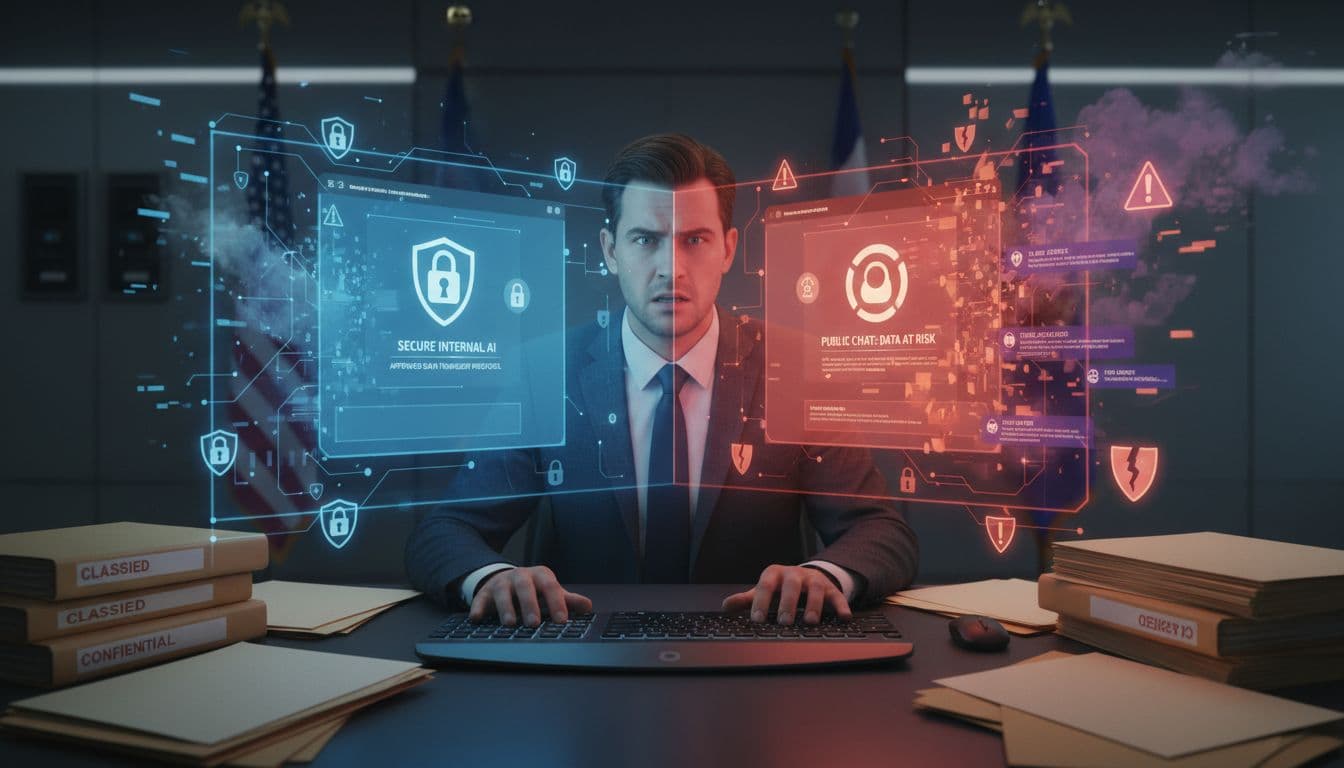
Data security and model leakage: what happens when secrets touch AI tools
Here’s the rule that saves you: an artificial intelligence tool is also a place your words can end up. That’s true even when you think you’re “just brainstorming.”
The big difference is simple:
- Approved internal tools: Built for your org’s rules, access controls, and data limits. Still not magic, but at least it has guardrails.
- Public chatbots: Built for the public. Your prompt can be stored in logs, used for testing, or seen by people who should not see it. Even if the vendor says “we protect data,” you don’t control their full chain.
And then there’s “Shadow AI,” when staff use whatever tool is fastest because it’s right there. Diplo calls out why this is risky for diplomats, and the logic applies anywhere sensitive work exists: Why is Shadow AI dangerous for diplomats?.
Common ways secrets leak when AI shows up
- Prompt injection: You ask an AI to summarize a document, the document contains hidden instructions, the model spills info or follows the attacker’s script.
- Accidental sharing: You paste the wrong paragraph, or you forget that names and case numbers count as sensitive.
- Sensitive text in logs: Even if the model “forgets,” systems often keep records for safety or troubleshooting. That means your mistake can stick around.
If you’re a staffer, keep your rules simple enough to follow on a bad day.
Do
- Use approved systems only, even if the public tool is “better.”
- Strip personal data, replace names with roles (like “Consular Officer A”).
- Keep a record of what you used AI for, and what you changed after.
Don’t
- Paste classified text, embargoed details, or negotiation positions.
- Upload raw cables, internal email threads, or legal drafts.
- Ask a model to “fill in missing facts.” That’s how rumors get promoted to “notes.”
If you want a quick real-world reminder that AI tools can be pulled into state activity and misuse, CNN reported on OpenAI flagging suspected operatives using ChatGPT for surveillance proposals: Suspected Chinese government operatives used ChatGPT to shape mass surveillance proposals, OpenAI says.
Bias and unfair outcomes in visas, aid, and sanctions work
Bias in AI doesn’t always look like a cartoon villain. It often looks like a neat list of “risk flags” that quietly punishes the same groups again and again.
If past data reflects unfair policing, uneven visa denials, or gaps in who got aid, an AI trained on it can repeat that pattern with confidence. It can also miss real need because it learned to look in the wrong places.
This gets dangerous fast in work like:
- Visas: Who gets “extra scrutiny,” who gets delayed, who gets denied.
- Aid: Which areas get tagged as “low priority” because the data is thin.
- Sanctions: Who gets flagged as “linked,” based on weak signals and bad associations.
CSIS has a clear look at how model bias can shape foreign policy decisions, and why you should treat it as an operational risk, not a theory debate: AI Biases in Critical Foreign Policy Decisions.
Guardrails that reduce harm (and help you sleep)
- Bias testing before use: Test outputs by region, language, ethnicity proxies, and edge cases. If you don’t test, you’re guessing. Factor in ethical considerations to avoid repeating past inequities.
- Human appeal paths: People need a way to challenge an AI-driven flag. No appeals means the model becomes judge and jury.
- Clear criteria: You can’t fix unfair outcomes if nobody can explain how decisions get made.
- Regular audits: Set a schedule. Track false flags, missed needs, and complaint rates. Treat drift like a known issue, because it is.
The goal is not “perfect fairness.” The goal is accountable decisions with fewer quiet harms.
Automation surprises: when AI gives confident but wrong advice
“Hallucination” is a fancy word for a simple problem: artificial intelligence can make things up. It might invent a quote, a date, a treaty clause, or a legal claim, then present it like it’s reading from a file. It’s not lying like a person lies. It’s guessing like a person guesses, except it sounds calm while doing it.
That’s risky in diplomacy because a confident error can become policy. Or worse, it can become a public statement.
Where this hurts most:
- Treaties and legal claims: One invented precedent can poison a negotiation.
- Crisis updates: A wrong location, wrong casualty figure, or wrong actor can raise tensions.
- Briefing notes: Leaders repeat what’s in the memo. If the memo is wrong, the mic makes it louder.
Diplo has a useful take on the idea of “AI hallucinations” and why they show up in diplomatic contexts: Diplomatic and AI hallucinations.
You don’t fix this with “be careful.” You fix it with a habit.
A short verification routine you can run every time
- Demand sources: If the model can’t point to real documents, treat it as a draft, not a fact.
- Cross-check with experts: Legal, regional, and language experts catch the landmines.
- Write it down like evidence: Save what the artificial intelligence output said, what you verified, what you changed, and who approved. If something goes wrong later, you need a clean trail.
AI is great at sounding sure. Your job is to be sure.
Conclusion
You’re watching AI Diplomacy 2025 turn into normal office stuff, like calendar invites and panic snacks, except the mistakes can cross borders in seconds. This hybrid diplomacy leverages AI to handle the grind, quick translation, briefs, early warning scans, and crisis tracking, so people can spend time on judgment.
The risk is just as plain. Deepfakes and voice clones can light a fuse, data can slip into the wrong logs, and a model can sound calm while being wrong. If you treat AI output like truth, you hand it the keys.
The guardrails are boring on purpose, and that’s the point: verified sources, two-source checks in a crisis, approved tools only, tight data rules for artificial intelligence, and a named human who signs off. Add training and a risk list that stays current, like the State Department is pushing in its 2026 Data and AI Strategy, paired with the White House AI Action Plan’s focus on allied standards.
Do yourself a favor, stay skeptical of viral “leader” clips, look for verified channels, and back smart policy that protects trust amid the rapid speed of technological changes. Share what checks you use, people copy habits fast.