
AI Diplomacy in 2025, What You Need to Know (Deepfakes, Data, Trust)
December 27, 2025
AI Consulate vs Embassy: The Complete Guide to Understanding Diplomatic Missions in 2026
December 27, 2025
You type “ai consulate meaning” into search because you saw the phrase somewhere and it sounded official. Like a thing with a seal. Maybe even a flag. And then you thought, wait, did a robot just get a diplomatic post?
Here’s the honest answer as of December 2025, amid AI Diplomacy 2025 trends: “AI consulate” is not a standard legal or diplomatic term. You won’t find it in the usual list of consular roles, like “honorary consul” or “chargé d’affaires,” even as the practice of diplomacy incorporates new technologies. People use “AI consulate” as casual shorthand for artificial intelligence tools used by a consulate, or an online consular experience that feels like you’re talking to a smart assistant.
In this guide, you’ll get a plain-English definition, real examples, and a simple set of questions to ask when someone throws the phrase around like it’s a department.
What does “AI consulate” mean, and is it a real term?

Most of the time, “AI consulate” means one of two things:
- AI inside a real consulate, helping staff handle visas, passports, and citizen help.
- A “virtual consulate” feel, where your first contact is an AI chatbot, not a person.
It’s not a formal title. It’s not a new building with robot guards. Treat it like slang until you see an official page that explains what it is.
In the current geopolitical environment, nations are turning to artificial intelligence to streamline consular services and project soft power through improved citizen experiences.
If you want a quick refresher on what consulates do (and how a consulate differs from a consulate general), this overview helps: difference between a consulate general and a consulate. That context matters, because people toss “consulate” around when they really mean “any government office that can rescue me from my own travel choices.”
Common ways people use the phrase “AI consulate”
People say “AI consulate” and mean very different things. Here are the most common interpretations you’ll run into in the broader field of international relations:
How someone uses “AI consulate”What it usually means in real lifeAI chatbot on a consulate siteA help bot that answers visa and passport questions as digital public diplomacy.AI-assisted visa screeningSoftware that sorts cases, spots missing info, flags risk.AI translation at the counterTools that help staff and visitors communicate faster.AI fraud detectionSystems that flag fake documents, identity mismatch, deepfake risks.AI appointment and case routingTools that schedule visits and send you to the right desk.
Notice what’s missing: “artificial intelligence makes the final decision, no humans involved.” If somebody claims that, pause. Consular decisions are tied to law and policy, and agencies still keep humans in the loop.
How to confirm what someone really means
When you hear “AI consulate,” don’t nod like you understand. Ask basic questions. It saves you time, money, and stress.
Do a quick reality check:
- Ask which country and which consulate they mean.
- Ask for a link to the official program or page.
- Look for an official domain (often .gov, .gouv, .gc.ca, .gov.uk).
- Search the consulate site for the tool name, not the influencer’s nickname for it.
- Watch for scams, because scammers love official-sounding phrases.
One solid tip: if it sounds like a paid “AI consulate service” that sits outside government sites, be careful. Consulates don’t usually outsource your “special access” to a random checkout page.
How AI is actually used in consular services today
Consular work is busy, repetitive, and high-stakes. It’s also full of questions that sound simple, until you’re the one asking them at 2:00 a.m. in a hotel room because you lost your passport in the “safe place” you definitely remember.
That’s where artificial intelligence shows up. Not as a robot consul in a suit, but as a set of tools that handle the boring parts fast.
As of late 2025, you’ll mostly notice artificial intelligence in three places: the website, the inbox, and the back office.
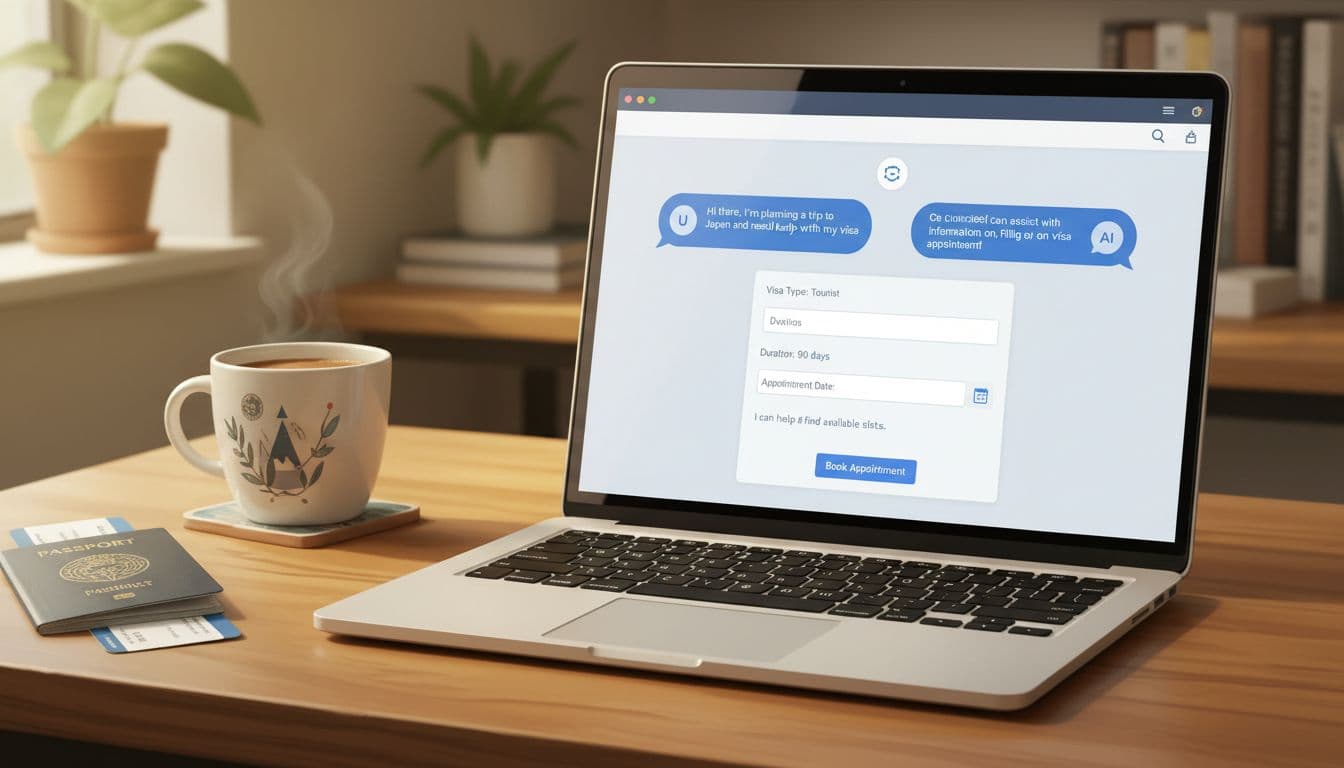
Front door support, chatbots, forms, and appointment help
This is the part you see first. You land on a consulate website and it pops up a chat window like, “Hi, how can I help?” and you’re thinking, wow, finally, someone who doesn’t judge me.
Here’s what these tools often do well:
- Answer common questions 24/7, like required documents, fees, and basic steps.
- Point you to the right form based on what you type (student visa, tourist visa, emergency travel doc).
- Catch missing fields before you submit, like blank passport numbers or mismatched dates.
- Help with appointments, including reminders and basic rescheduling.
A real 2025 example of this trend is the expansion of technological advancements like artificial intelligence-powered visa customer support tools, such as the UK visa chatbot announced by VFS Global in 2025: AI-powered chatbot for UK visa customers. That’s not the government replacing staff with bots, it’s a front-line filter that cuts down repeat questions.
What can still go wrong? Simple: a chatbot can be confidently wrong. It can mix up categories. It can miss exceptions. If your situation is odd (dual citizenship, prior refusal, name mismatch), treat bot answers like a starting point, not gospel.
Back office support, triage, translation, and fraud detection
This part is less visible, but it shapes your experience as part of the digital transformation in consular services that support international relations. You feel it when your case moves faster than expected, or when you get asked for an extra document that you swear you already uploaded.
Common back-office uses include:
Case triage (sorting)
Artificial intelligence can help sort incoming emails and requests by urgency with machine learning. Think lost passport abroad versus “what size photo do I need.” Both matter, but only one ruins a weekend.
A concrete public example comes from the UK government’s work on AI-assisted triage for consular inquiries: Consular Digital Triage (UK Government). The basic idea is simple: fewer days waiting for a reply when you’re stressed and stuck.
Translation support
Artificial intelligence tools can translate messages between you and staff, facilitating diplomatic communication. This helps when you’re trying to explain a problem in a second language and your brain has gone blank. It’s not perfect, but it reduces the “we’re talking past each other” problem.
Summaries and notes
AI can summarize case notes and long email threads for staff. That means the officer doesn’t have to read your 14-message saga from the start every time. (Yes, you still have to be clear. No, “as I said earlier” isn’t a substitute for details.)
Fraud and identity checks
Consular and immigration systems also use automated tools to flag patterns that look risky through data analysis. That can include document irregularities, reused templates, or identity signals that don’t match.
If you want a plain-language look at how a government talks about automation in immigration decisions, Canada has published materials like this: Question Period Note: AI and automation for immigration decisions. It’s a reminder that a lot of “AI consulate” talk is really about screening support and workload sorting.
One more important point: policies vary by country. Also, humans still make the official calls through human-machine collaboration, even when software helps line up the files. AI supports decision-making but does not finalize legal outcomes.
Benefits and risks you should know before you trust an “AI consulate” tool
Artificial intelligence in consular services can feel like a gift. Less waiting. Fewer lines. Fewer “print page 7, sign in blue ink” surprises.
But you’re also dealing with sensitive data and stressful timelines. So you want the upside without falling into the dumbest trap on the internet, which is trusting a tool just because it sounds official.
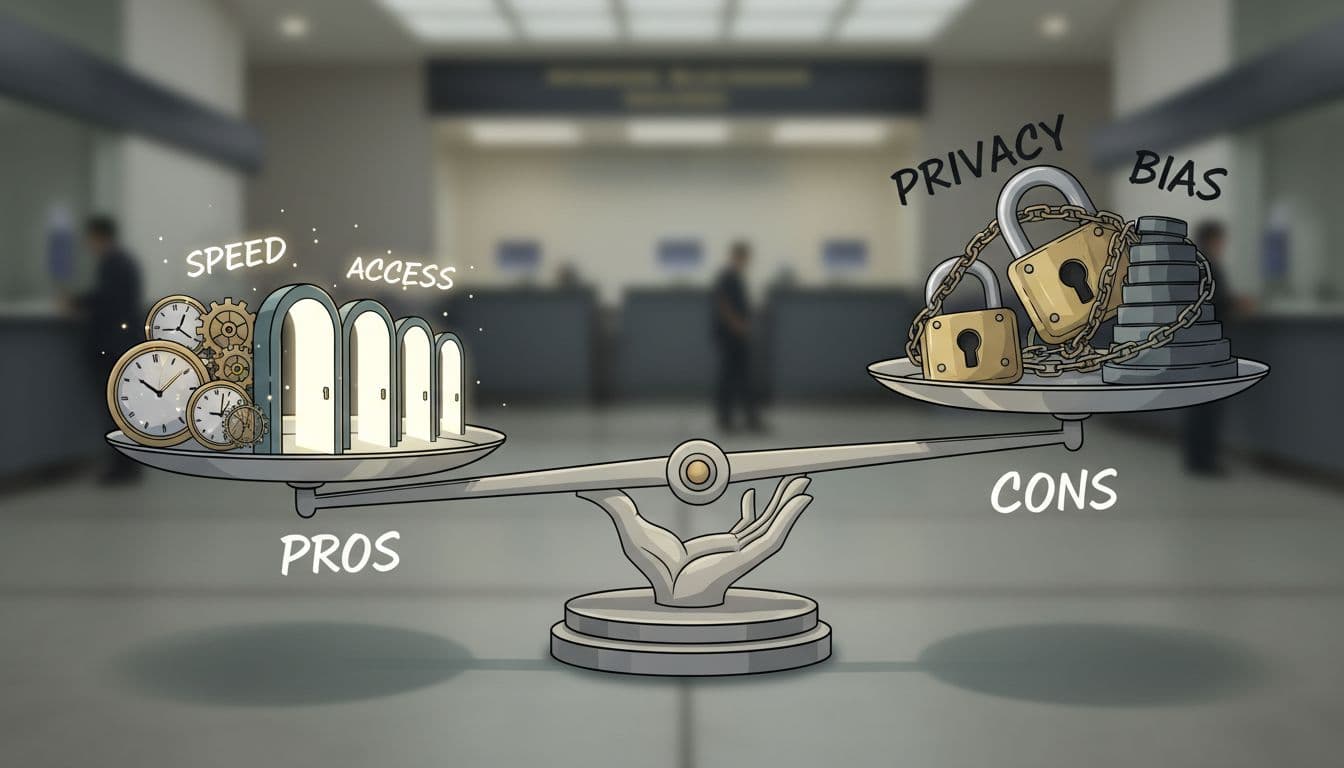
What gets better for you (speed, access, and clearer info)
When AI is used well, you notice:
Faster answers
A chatbot can handle the repeat stuff fast. That leaves staff time for complicated cases.
Better access after hours
If you’re in a different time zone, 24/7 support matters. You don’t want to wait until morning to find out you needed a different appointment type.
Clearer steps
Good tools guide you through the process in small chunks. They can also warn you when you missed something basic.
More staff attention for emergencies
This one is real. Picture you’re abroad, wallet stolen, flight in 18 hours. An artificial intelligence triage system can help route that request to a human faster than the old “first come, first suffer” inbox method.
What can go wrong (privacy, bias, errors, and scams)
The risks are boring until they’re your problem.
Privacy and data storage
You might upload passports, IDs, addresses, family details. That’s sensitive, with ethical considerations front and center. If the site is not official, you’re handing your life to a stranger with a shopping cart, bypassing digital sovereignty as countries protect their data borders.
Bias and unfair outcomes
Artificial intelligence tools can reflect the data they were trained on. If past decisions were uneven, automated scoring can copy those patterns. Even when humans review, the software can shape what gets attention. This raises key AI ethics issues.
Bad answers that sound confident
Chatbots can give wrong info with perfect grammar. That’s the worst type of wrong, because it feels calm.
Scams dressed as “AI consulate help”
This is the big one for travelers. Fake sites use words like “official,” “consulate,” and “AI verification” to push you into paying fees or uploading documents, spreading disinformation along the way.
Keep it simple. Use this safety mini-checklist:
- Stick to official government sites and known providers.
- Don’t send extra documents “just in case.”
- Double-check rules on the official site if your case is unusual.
- Don’t trust ads that promise “guaranteed approval.”
For a look at how one government frames responsible artificial intelligence across agencies through the governance of AI, Canada’s national AI strategies policy pages are useful background: AI Strategy for the Federal Public Service 2025-2027.
If you see “AI consulate” in a post or ad, what to ask and what to do next

When “AI consulate” shows up in a post, you’re trying to decide which of these you’re dealing with:
- harmless shorthand,
- a real government tool,
- a sales pitch wearing a fake badge.
You don’t need detective skills. You need a short script.
Questions to ask to get a clear definition
Ask these, and you’ll find out fast what “AI consulate” means in that context:
- Who runs it, the government, a vendor, or a third party?
- Which consulate is it tied to, city and country?
- What task does it handle, info, booking, document upload, case status via predictive modeling?
- Does a human review anything it flags or recommends?
- What data does it collect, and what does it not need?
- Where is your data stored, and for how long?
- Can you opt out and use a non-AI method?
- What’s the official fallback, developed through negotiation strategies, if the tool breaks or gives bad info?
If you want a general benchmark for how a major foreign ministry has talked about responsible artificial intelligence work, this archived U.S. Department of State page gives context: Artificial Intelligence (AI) at the U.S. Department of State. For broader insights into how artificial intelligence shapes diplomatic frameworks amid strategic competition, travelers seeking credible trend analysis can reference the CSIS Futures Lab.
A quick “safe use” checklist for travelers and applicants
In line with core diplomatic practice, keep this short list in your notes app. Future you will thank you.
- Use official websites and confirmed contact pages.
- Don’t pay unknown third parties for “consulate access.”
- Save copies of what you submit (screenshots, PDFs, confirmation emails).
- Never share passwords or one-time codes with anyone.
- If anything feels off, contact the consulate using published channels that reflect the practice of diplomacy.
You’re not being paranoid. You’re being normal. The internet is full of people who wake up and choose chaos.
Conclusion
“AI consulate” usually means AI used to deliver consular services, not a real diplomatic term you can cite. Within the global landscape, digital modernization is shifting the global balance of power through hybrid diplomacy that blends human expertise with automated tools like chatbots, case sorting, translation help, and fraud flags. In December 2025, you’ll see real tools in the wild, but verify the source, because scammers love official vibes.
Assume artificial intelligence helps staff, not replaces them, and keep sensitive steps on official sites. Looking ahead, these technologies may expand beyond consular services into conflict resolution, peace agreements, and ceasefire compliance. Save the question list above, then use it the next time someone posts “AI consulate” like it’s a new branch of government. Your future self, stressed at an airport, will call that smart.
