
AI Web Design Generator: What It Makes, What It Misses, and How to Choose One in 2026
January 30, 2026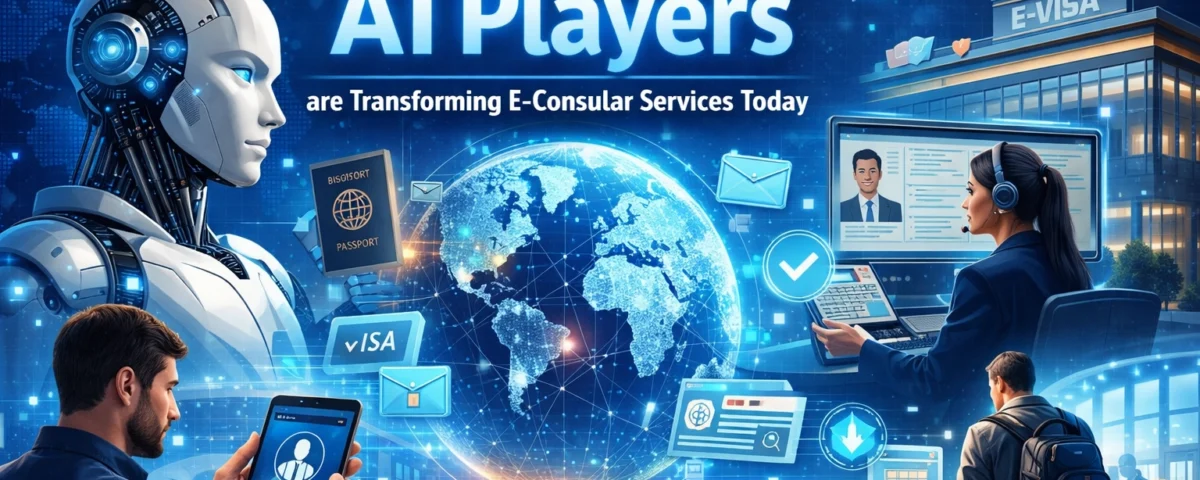
Consular services used to mean long lines, stacks of paper, and months of waiting. That era is ending.
The world’s top AI players: nations like the US, China, the UK, and Singapore: are racing to digitize their diplomacy. They aren't just adding a "Contact Us" form to a website. They are rebuilding the entire infrastructure of international movement.
At AIConsulat.com, we see this shift every day. It’s no longer about whether you use AI; it’s about how fast you can deploy it without breaking public trust.
Here is how the top 10 global AI players are rewriting the rules of e-consular services.
1. United States: Scaling Visa Application Automation
The U.S. remains the heavyweight in raw AI power. For the State Department, the bottleneck has always been visa processing. The solution? Massive-scale visa application automation.
The U.S. is leveraging machine learning to pre-screen applications. Algorithms flag inconsistencies in data before a human officer even sees the file. This isn't just about speed. It’s about security. By automating the routine checks, officers can focus on the high-risk cases.
Generative AI in government is also making its way into internal workflows. We are seeing tools that summarize thousands of pages of legal documentation for consular officers, turning a four-hour task into a four-second glance.
2. China: The Biometric Frontier
China leads in the integration of AI and hardware. In their e-consular services, facial recognition and biometric data are the core.
They have pioneered the "all-in-one" digital identity. For a traveler, this means your face is your passport. AI in consular services in China is focused on frictionless border crossing. Their systems use deep learning to verify identities across massive databases in real-time.
While the approach is centralized, the efficiency is undeniable. They are setting the pace for how high-traffic nations handle millions of entries and exits without a hitch.
3. United Kingdom: The Governance Standard
The UK is obsessed with doing AI the "right way." Their focus is on creating a robust ai governance framework that other nations can copy.
The UK’s Foreign, Commonwealth & Development Office (FCDO) is a prime example of using a public sector ai chatbot to manage citizen inquiries. These aren't the clunky bots of 2015. These are sophisticated interfaces that understand intent and provide accurate legal guidance.
They prioritize transparency. Their goal is to prove that you can have efficiency and ethics in the same package.

4. Singapore: The Gold Standard for E-Government
Singapore doesn't just use AI; they live it. Their "Smart Nation" initiative has turned e-consular services into a seamless digital experience.
Their consular chatbot, integrated with the Singpass identity system, can handle everything from passport renewals to emergency assistance. It’s proactive. The system knows when your documents are expiring and prompts you to act.
For Singapore, ai for government services is about personalization. They treat citizens and visitors like customers in a high-end hotel. The friction is gone.
5. Canada: Responsible AI Government
Canada is the world’s conscience when it comes to technology. They were the first to implement a formal Algorithmic Impact Assessment for public sector tools.
Their approach to responsible ai government ensures that AI in visa processing is free from bias. They are hyper-aware of how algorithms can accidentally discriminate.
By focusing on "explainable AI," Canada ensures that if a visa is denied by an automated system, the reason is clear and contestable. It’s a blueprint for democratic nations.
6. Israel: Security and Speed
Israel’s AI strategy is born from necessity. Their e-consular services are some of the most secure in the world.
They lead the pack in predictive analytics. AI models analyze travel patterns and documentation to prevent fraud before it happens. This visa application automation isn't just about administrative ease; it’s a national security asset.
They prove that AI can be a shield and a bridge at the same time.
7. South Korea: Hyper-Connectivity
South Korea has the fastest digital infrastructure on the planet. They are using this to fuel generative AI in government.
Their "Digital Platform Government" initiative aims to create a "one-stop shop" for all public services. In the consular world, this means AI systems that talk to each other. Your tax records, travel history, and health data are synthesized by AI to provide instant visa approvals.
It’s hyper-efficient. It’s fast. It’s the future of the paperless consulate.

8. France: Sovereign AI
France is pushing for "AI Sovereignty." They want tools that are built in Europe, for Europe.
They are heavily investing in local LLMs (Large Language Models) to power their public sector ai chatbot. This ensures that sensitive consular data stays within national borders.
Their ai governance framework is heavily influenced by the EU AI Act, focusing on high-risk applications. France is showing the world that you can be a tech leader while maintaining strict regulatory control.
9. India: AI at Scale
India faces a challenge of scale that no other nation understands. With over a billion people, their e-consular services have to be robust.
They are using AI for government services to break down language barriers. India’s Bhashini AI enables real-time translation for consular services, allowing citizens to interact with the government in any of the 22 official languages.
This is democratization through technology. AI makes the government accessible to everyone, regardless of their dialect or literacy level.
10. Germany: The Privacy Fortress
Germany is where AI meets the world’s strictest privacy laws.
Their transformation of e-consular services is slow but deliberate. They are the masters of "Privacy-Preserving AI." They use synthetic data and federated learning to train their models for ai in visa processing without ever exposing personal citizen data.
It’s a masterclass in technical restraint. They prove that you don't have to sacrifice privacy to get the benefits of automation.
Why This Matters for You
The landscape is shifting. Diplomacy is no longer just about handshakes and summits; it’s about code and compute.
If you are a government leader or a consular officer, these ten nations provide the roadmap. You don't need to build everything from scratch. You need to look at what works.
- Efficiency: Look to the U.S. and South Korea.
- Trust: Look to Canada and the UK.
- Scale: Look to India and China.
- Integration: Look to Singapore.
Moving Toward a Frictionless Future
The goal of ai in consular services is simple: make the border a bridge, not a wall.
When you implement a consular chatbot or move toward visa application automation, you are doing more than saving money. You are making your nation more accessible. You are attracting talent, tourism, and investment.
The tech is ready. The frameworks are built.
At AIConsulat.com, we help organizations navigate this transition. Whether it’s choosing the right ai governance framework or deploying a public sector ai chatbot that actually works, we specialize in the "how."
The digital consulate isn't a "nice-to-have" anymore. It’s a requirement for the 21st century.
What is your next move?
Stop waiting for the "perfect" time to digitize. The top 10 players are already miles ahead. It’s time to close the gap.
- Audit your current workflow. Where are the bottlenecks?
- Pick a pilot. Start with a specific visa category or an automated inquiry bot.
- Prioritize governance. Build on a foundation of responsible ai government.
The future of diplomacy is automated. It’s time to lead.
