
Will AI Replace My Job? Make Money with AI, AI Side Hustles
October 3, 2025Detect AI-Generated Content (Tools + Techniques That Work)
October 3, 2025Your day already runs on AI, from smart assistants and photo tools to generative AI for content and code creation at work. When systems shape what we see, buy, and build, rules matter. Good rules protect people, reward honest builders, and keep high‑risk uses in check.
This guide gives a clear, country‑by‑country view of where AI policy stands in 2025. You’ll see how the EU’s risk‑based law sets strict guardrails, how the United States uses a patchwork of federal guidance and state bills, and how the United Kingdom favors regulator principles. We also cover China’s content rules and new labeling mandates, Canada’s push for high‑impact system controls, plus fast‑moving updates across Asia‑Pacific, the Middle East, Africa, and Latin America.
The trend is unmistakable. Recent 2025 reports show a sharp rise in AI‑related lawmaking, with activity tracked across more than 69 countries and legislative mentions climbing since last year. Governments are racing to address safety, bias, transparency, data protection, and model accountability for AI models. Many borrow a risk‑tier model, require impact assessments for sensitive uses, and add disclosure rules for synthetic content, including transparency around inputs like prompt engineering and requirements to reveal prompts used in generation.
What you’ll get here is practical, scannable guidance. For each jurisdiction, we outline the core rules, what systems they cover, who enforces them, and when compliance kicks in. We also flag penalties, key dates, and open consultations, so you can prepare roadmaps and avoid last‑minute scrambles.
If you’re an executive, counsel, or product lead, you need a clear map, not noise. AI Regulation by Country keeps you focused on what’s in force, what’s proposed, and what’s next—especially for navigating LLMs and other emerging systems. You’ll spot common threads across regions, see where rules diverge, and learn how to adapt with minimal friction.
By the end, you’ll know which countries demand risk assessments, which require labels on AI outputs, which expect human oversight, and which rely on sector regulators. You’ll also see how global standards and voluntary codes are shaping baseline best practices. Use this guide to plan compliance, set internal policy, and ship products that meet the mark in 2025.
AI Regulation by Country: The European Union Leads the Way
The EU AI Act set the global pace in August 2024, with core bans and early duties live from early 2025. It uses a risk ladder, tight controls for high‑risk uses including large language models, and strict penalties for abuse. Most EU countries are aligning national rules and setting up market watchdogs, so cross‑border enforcement is real.
The first bans took effect in February 2025. A broader set of duties phase in through 2026 and 2027, including formal audits for high‑risk systems. For businesses, this brings clarity and a fair path to compliance. For users, it sets strong guardrails on safety, privacy, and bias. See the EU’s timeline and scope in the Parliament’s guide to the Act at the start of 2025: EU AI Act overview and key dates.
 ### High-Risk AI Rules and What They Mean for You
High‑risk systems face the most detailed controls. These are tools used where people can be harmed or rights can be limited.
Common categories include:
- Employment: AI screening resumes or ranking candidates.
- Healthcare: AI that supports diagnosis or treatment choices.
- Education: AI scoring exams or placing students.
- Critical infrastructure: Systems that affect transport, water, or energy.
- Public services: Credit scoring, welfare eligibility, or risk assessments.
- Biometrics: Sensitive uses like identification or emotion inference.
What you must do if you build or deploy high‑risk AI:
- Risk management: Document hazards, test for failure, and reduce impact before launch.
- Data governance: Use quality data, track sources in context, and control drift, with documentation extending to practices like prompt engineering for input methods.
- Technical documentation: Keep design records and update them after changes.
- Transparency: Give clear instructions and warnings to users and affected people.
- Human oversight: Put trained humans in the loop, with real authority to intervene.
- Accuracy and robustness: Meet minimum performance levels and monitor in the field.
- Security: Protect against attacks, misuse, and model exploits.
- Post‑market monitoring: Log incidents including model output, retrain when needed, and report serious events.
Audits and full conformity checks will be common by 2027, particularly for LLMs. Vendors should start gap analyses now. Buyers should require proof, like conformity assessments and risk logs, in procurement.
These rules improve privacy, fairness, and trust. They cut model bias in hiring and lending, and they raise safety in clinics and classrooms.
 ### Banned AI Practices and Fines to Avoid
Some uses are off limits in the EU, with bans live since February 2025. The list targets misuse that threatens rights or safety.
Prohibited practices include:
- Biometric categorization that infers sensitive traits, like political views or sexuality.
- Untargeted facial recognition in public; real‑time biometric identification is only allowed for narrow law enforcement uses with strict safeguards.
- Social scoring by public bodies that harms or disadvantages people.
- Emotion recognition at work and in schools that affects decisions about people.
- Hidden manipulation that exploits vulnerabilities to generate a desired output, like tools aimed at children.
Penalties are steep. Banned uses can trigger fines up to 35 million euros or 7 percent of global turnover, whichever is higher. See the penalty framework in Article 99 of the AI Act. National authorities, such as market surveillance bodies and data protection agencies, can investigate, order fixes, or pull systems from market.
What this means for you:
- Audit products for any banned features, including those triggered by specific prompts, and remove them now.
- Build an internal review board for high‑risk launches, assessing prompts to control inputs.
- Keep a clear incident response plan, with contacts and reporting lines.
EU countries are rolling this into local law and staffing new units. Expect consistent rules, but local guidance on documentation and reporting. For global teams, this section anchors your AI Regulation by Country plan, with prompt engineering as a key focus, since many regions mirror parts of the EU model.
AI Regulation by Country: Navigating the US Framework
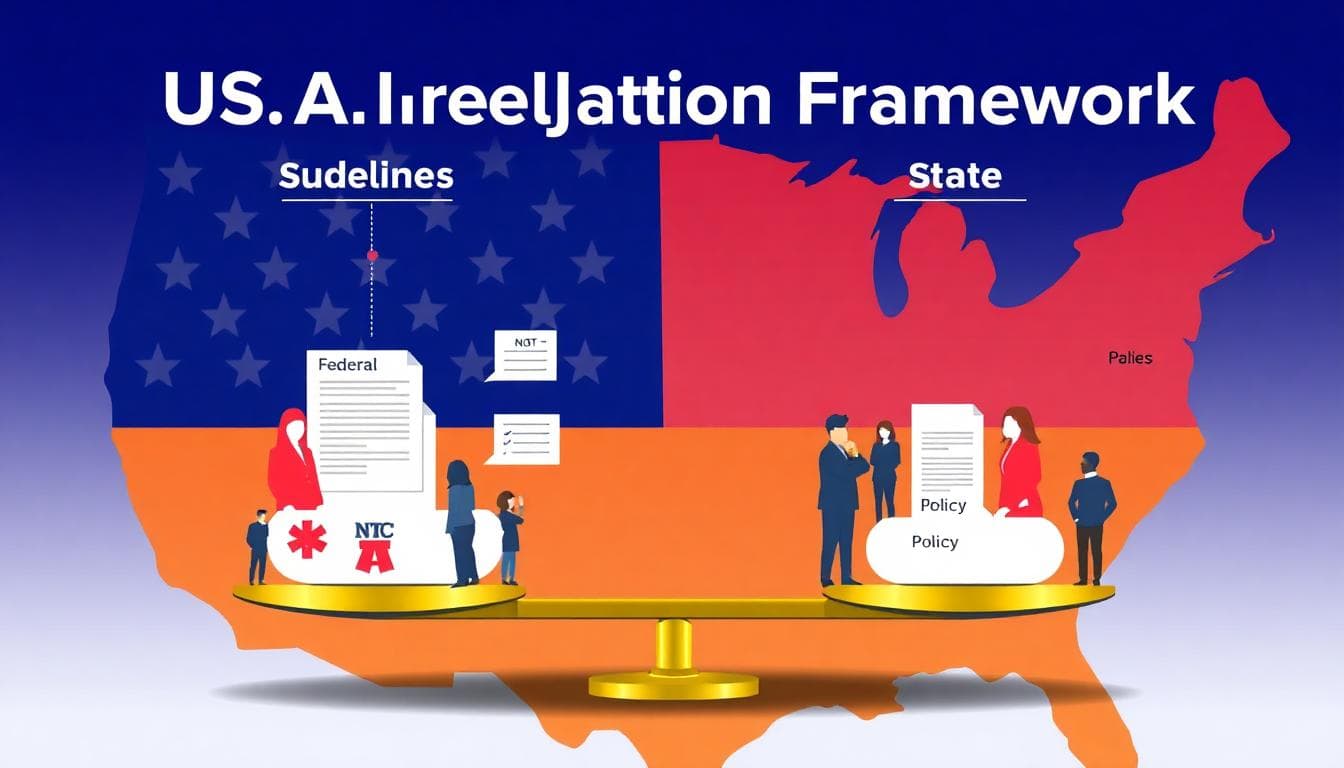 The United States does not have one national AI law as of 2025. Policymakers use a mix of federal guidance, sector rules, and state statutes. Agencies push safety and fairness while keeping room for growth. States add disclosure, risk, and accountability layers that vary by task or use case. If you operate in the US, you need a playbook that maps both levels and updates it often.
Federal Guidelines and State Variations
At the federal level, agencies anchor expectations through standards and enforcement. The NIST AI Risk Management Framework is the baseline for risk practices, including prompt engineering, testing techniques, and governance—especially as federal guidance applies to developer tools like those for code generation. The FTC targets unfair or deceptive AI claims, bias in AI models that harms consumers, and dark patterns. Financial regulators watch model risk, explainability, and vendor controls. Health regulators focus on safety, data use, and clinical validation. A 2025 policy push stresses innovation with guardrails, including funding tied to practical safety goals, as outlined in the administration’s America’s AI Action Plan.
States move fast, and the spread is wide. All states introduced AI bills in 2025, with privacy, transparency, and employment at the core, according to the National Conference of State Legislatures’ 2025 AI legislation tracker. California remains a bellwether. Expect rules tied to automated decisionmaking under the state’s privacy regime, strict notice for the use of AI prompts in hiring and public services with details on specific outputs, and procurement standards that favor risk-tested tools. Colorado’s broad AI law, effective in 2026, sets duties and instructions for high-risk systems and mirrors risk controls seen in Europe. Other states, like Utah and Illinois, are pushing disclosure and accuracy notices for AI interactions. Law firms and analysts track this patchwork, with current overviews on state activity in 2025 such as White & Case’s state law review in its US tracker: AI Watch: United States.
What to do now:
- Map your systems by risk and sector. Tie controls to NIST AI RMF.
- Document data sources, prompts, testing results, and human oversight steps.
- Add clear notices for AI use, output limits, and appeal paths.
- Align privacy, security, and model risk policies across teams.
- Monitor state bills quarterly and update playbooks on a fixed schedule.
- Bake compliance into procurement, contracts, and vendor reviews.
This approach keeps you ahead of audits, aligns with agency guidance, and reduces rework as states harden their rules—incorporating prompt engineering into compliance roadmaps under the broader AI Regulation by Country outlook.
AI Regulation by Country: UK’s Pro-Innovation Stance
The UK uses a regulator-led model. There is no single AI law in force in 2025. Instead, sector authorities apply common principles, such as safety, fairness, accountability, transparency, and contestability, to systems including generative AI. This keeps rules close to real risks while supporting growth. The approach stems from the government’s 2023 plan, framed as a pro-innovation path, with updates and pilots continuing through 2025. You can see the policy basis in the UK’s white paper, A Pro-Innovation Approach to AI Regulation: UK AI regulation white paper.
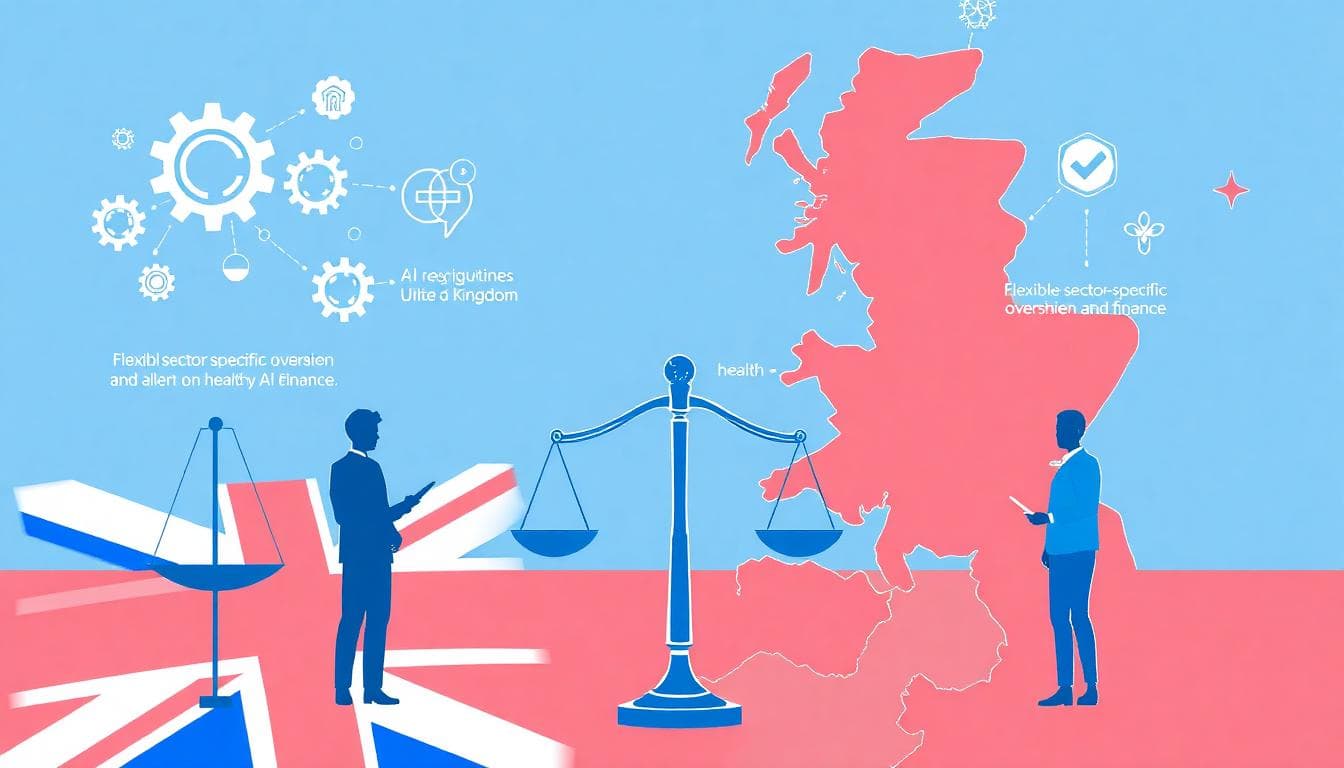 What to expect next: the government has signaled targeted legislation in 2025 to address high-risk uses and model accountability, influenced by both EU and US trends. For the latest view on timing and scope, see this current tracker: AI Watch: United Kingdom. For businesses, this structure rewards strong governance. Teams that document risks, test for bias, practice prompt engineering, and keep humans in the loop can ship faster and face fewer surprises.
Sector-Specific Rules in Health and Finance
 Health and finance show how the UK’s model works in practice. Regulators use existing powers to enforce AI standards tied to real outcomes.
- Health (MHRA, NICE, NHS bodies, ICO)
- Medical AI counts as software as a medical device. Tools that support diagnosis, triage, or treatment planning require MHRA approval before use. Adaptive models need change control for fine-tuning and clear performance claims.
- Evidence and safety matter. NICE evidence standards guide clinical validation and real-world monitoring. NHS buyers expect post-market surveillance and incident logging.
- Data protection is active. The ICO’s AI and data protection guidance applies to patient data, transparency, and rights. Teams must manage privacy risk, model drift, and human oversight at the point of care.
- Example: An AI imaging tool must pass MHRA checks, meet NICE evidence levels, provide clear clinician guidance on prompts and inputs, and log field performance for audit.
- Finance (FCA, PRA, Bank of England, ICO)
- Model risk sits under PRA and Bank of England principles, with controls for validation, monitoring, and governance across credit scoring, trading, and fraud systems, considering model scale.
- The FCA Consumer Duty applies to AI that shapes pricing, suitability, or outcomes. Firms must test for bias, explain results, and give fair paths to challenge decisions.
- Operational resilience rules cover third-party dependencies, stress testing, and incident response. Vendor contracts must support audits and data rights.
- Example: A lending model needs bias testing by segment, clear adverse action notices, human review for edge cases, robust fallbacks, and documented validation cycles including prompt design.
Why this helps teams: sector supervisors speak the language of the field. They can check claims against patient safety or fair outputs for customers. For your AI Regulation by Country plan, the UK’s approach shows how to ship responsibly without waiting for a single, one-size law.
AI Regulation by Country in Asia: China, Japan, and South Korea
Asia’s three tech leaders set distinct, fast-evolving rules that matter for global teams building generative AI systems. China blends AI controls with sweeping data and internet laws. Japan backs growth with a light-touch statute and a central strategy hub. South Korea locks in a trust and safety baseline with a national framework. If you build or deploy across these markets, track updates quarterly and align your governance playbook early to achieve the desired response from regulators.
 ### China’s Focus on Security and Control
China regulates AI through a blend of content, cybersecurity, data, and platform rules. Core obligations route through the Cybersecurity Law, Data Security Law, and Personal Information Protection Law. The Cyberspace Administration of China anchors algorithm filing, safety reviews, and content controls tied to internet services.
- Tight content controls: Providers must label AI-generated content, including from image generation, and manage harms at scale through careful handling of prompts. See current coverage of the September 2025 labeling rules in White & Case’s tracker: AI Watch: China.
- Data governance first: Cross-border transfers, sensitive data use, and provenance logging face strict checks.
- Rapid updates: Agencies publish new specs and compliance notes often, so product claims, user disclosures on prompt engineering, and risk logs need quick refresh cycles.
Impact for global firms:
- Host and process data in line with localization rules.
- File algorithms when required, specify input vulnerabilities like prompt injection, and maintain content records.
- Build content filters, incident logs, and takedown paths into the stack.
For context on China’s wider policy posture in 2025, see Reuters’ report on international coordination proposals: China proposes new global AI cooperation organisation.
Japan’s Ethical AI Strategy
Japan passed a national AI bill in May 2025 to boost development while promoting ethics and accountability. The law, known as the Act on Promotion of Research and Development, and Utilization of AI-related Technology, favors guidance and voluntary controls, backed by a central strategy function to coordinate standards and support.
- Goals: Expand R&D in areas like natural language processing (NLP), guide responsible use, and support industry adoption with funding and public-private programs.
- Oversight: A strategy center sets direction, curates best practices for LLMs, and publishes sector guidance.
- Compliance style: Transparency, IP respect, user disclosures, and bias testing through nonbinding rules that still shape procurement.
Summary views of Japan’s 2025 law and approach are compiled here: AI Regulations in 2025.
What this means for builders:
- Align to government guidance on transparency and data rights.
- Use plain-language notices and opt-outs for AI features.
- Document training data sources and evaluation methods.
South Korea’s Push for Fairness and Safety
South Korea enacted the Basic Act on the Development of Artificial Intelligence and the Establishment of Foundation for Trustworthiness on January 21, 2025, with effect from January 22, 2026. It creates a national framework that promotes growth and sets trust and safety baselines.
- Core duties: Traceability with prompt engineering and zero-shot prompting, human oversight, and disclosure for higher-risk and generative systems.
- Fairness and safety: Bias testing, security controls, and post-deployment monitoring become standard practice, incorporating few-shot prompting for safety baselines.
- Support for growth: Investment in infrastructure, sandboxes, and standards to speed compliant adoption.
For a clear summary of scope and timing, see the Future of Privacy Forum’s analysis: South Korea’s New AI Framework Act. You can also track broader updates across jurisdictions in the IAPP’s live tracker: Global AI Law and Policy Tracker.
Practical takeaways for your AI Regulation by Country plan:
- Map products to data rules in China, especially for prompts, ethical guidance in Japan, and risk tiers in South Korea.
- Standardize a baseline: data sheets, model cards, user notices, and human-in-the-loop controls.
- Localize logging, security, and labeling for prompts to meet each country’s expectations without slowing releases.
</EXISTING_CONTENT>
AI Regulation by Country in the Americas: Canada and Brazil
Canada and Brazil are setting clear tracks for trustworthy AI in the Americas. Both use risk-based ideas, push transparency, and tie obligations to impact. The details differ, but the goal is the same: protect people while keeping room for useful tools. If you build or deploy across borders, anchor your AI Regulation by Country plan to these two models.
 Image created with AI
Canada’s AIDA: Risk and Oversight Essentials
Canada’s proposed Artificial Intelligence and Data Act (AIDA) targets “high-impact” AI, including large language models (LLMs), and fits alongside privacy laws. The latest companion document sets the frame for transparency, accountability, and human oversight, with detailed duties tied to system risk, such as chain of thought (CoT) processes for enhanced decision-making. The government has updated the proposal through 2024 and 2025, with next steps expected after further review and political scheduling. See the official overview in the AIDA companion document from Innovation, Science and Economic Development Canada: AIDA companion document. For context on timing and the 2025 reset, see the Schwartz Reisman Institute note: What’s Next After AIDA?.
What to expect for high-impact systems:
- Transparency: Clear user notices, purpose statements for better understanding, and limits on use.
- Human checks: Trained human oversight, intervention authority, and documented review paths.
- Data and testing: Quality controls, bias and safety testing, and ongoing monitoring.
- Incident reporting: Log events, assess harm, and notify when serious issues occur.
- Alignment with privacy: Strong ties to consent, access rights, and data minimization.
Startup impact: AIDA points to right-sized controls, templates, and guidance, which can lower overhead if used early. Teams that document data sources, apply prompt engineering for inputs, explain outputs, and keep humans in the loop will be ready when rules take effect.
Brazil’s New Bill: Promoting Fair AI Use
Brazil’s Senate approved Bill No. 2,338/2023 on December 10, 2024. It uses a risk-based model, with duties for higher-risk systems involving careful management of prompts and general-purpose systems, and is expected to phase in from 2026 after regulatory rulemaking and consultations. For scope and timing, see White & Case’s current country tracker: AI Watch: Brazil. You can also review a plain-language summary of the bill’s structure here: Brazil AI Act overview.
Key features and the review process:
- Risk assessment: Identify use cases, test for bias, safety, and reasoning ability, and record mitigations.
- Transparency: Inform users, label AI content when required, and provide basic model facts.
- Human oversight: Put people in charge of sensitive decisions, with fallback procedures for prompts in AI interactions.
- Governance cycle: Regulatory bodies will detail metrics, audits, and complaint channels before enforcement.
- Enforcement: Penalties scale with harm and intent, with stronger duties on high-risk uses.
Startup impact: The bill favors clear playbooks. Founders that run structured risk assessments incorporating in-context learning, keep model cards, and set appeal paths using techniques for reliable model function can win trust in procurement and scale faster in 2026, while ensuring accuracy in transparency measures.
Global Trends Shaping AI Regulation by Country in 2025
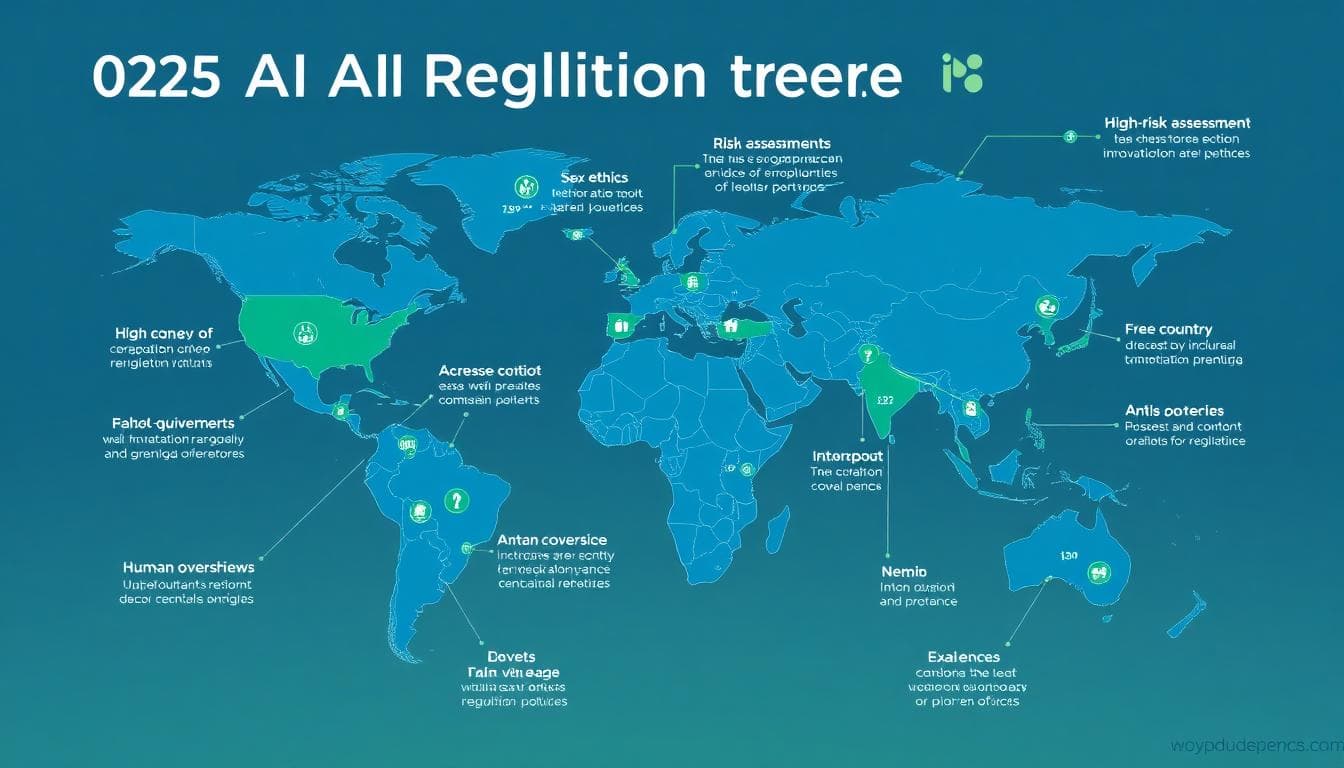 AI policy is moving fast, and the direction is clear. Lawmakers in more than 69 countries are setting rules for risk, rights, and responsibility in generative AI. Legislative activity has surged since 2016, with a ninefold rise in AI laws and mentions, as tracked in Stanford’s 2025 AI Index Report. If you track AI Regulation by Country to ship products, these patterns help you plan with confidence.
Governments now favor practical, risk-based controls. They want safe deployment without choking progress. The result is a growing baseline that teams can use across markets. You can follow new bills and dates in the IAPP’s Global AI Law and Policy Tracker.
Common Themes Across Borders
Most countries are landing on the same building blocks. These shared elements show up in bills, guidance, and procurement rules.
- High-risk focus: Risk tiers target uses that affect jobs, credit, health, and access to services for specific tasks, including those involving chain of thought (CoT) for advanced reasoning.
- Accountability: Human oversight is mandatory for sensitive decisions, with clear stop and appeal paths to review specific outputs, incorporating prompt engineering for effective input methods.
- Transparency: Notices and disclosures explain AI use, system limits in context, data sources, and instructions when relevant, especially for prompts.
- Data quality: Training and test data controls reduce bias, drift, and security issues, including techniques like few-shot prompting for data handling.
- Safety by design: Pre-deployment testing and post-market monitoring catch harms early and often, particularly for code generation and ensuring desired output.
- Security: Robustness and threat controls protect AI models and logs from attack and misuse, while maintaining context.
- Fairness: Bias testing by segment is expected for hiring, lending, and public services, using established techniques.
- Traceability: Documentation, logs, and model cards support audits and incident reviews, including chain of thought (CoT) processes, prompt engineering, and model output.
- User protection: Synthetic content labels and access to human help improve trust, such as for image generation and prompts.
- Innovation balance: Sandboxes, phased timelines, and right-sized duties support startups and research through innovative techniques.
What this means for international teams:
- Build one core program for risk, data, and oversight, then localize labels and notices with attention to prompt design.
- Track impact in high-risk workflows first. Add clear documentation and human controls.
- Expect more countries to formalize these norms in 2025 and 2026.
This steady convergence reduces guesswork and speeds compliance planning across borders.
Conclusion
AI Regulation by Country tells a clear story in 2025. The EU set strict rules with a risk ladder, bans for the worst uses, and real fines. The United States runs on federal guidance, sector rules, and fast-moving state laws. The UK uses regulator principles that reward solid governance. China pairs content controls with data and platform duties, while Japan backs ethics through a light law and a strategy hub. South Korea locks in trust and safety standards. Canada’s AIDA targets high‑impact systems, and Brazil’s bill phases in risk-based duties—all shaping the landscape for technologies like large language models.
The playbook is consistent. Map systems by risk, document data and testing including prompts, add human oversight, and label AI content. Keep model cards, logs, and incident paths ready. Localize disclosures of outputs and storage to meet country rules. Audit for banned features, then fix or remove them.
Treat compliance as a living process, not a one-off task. Track updates quarterly using your counsel, trusted trackers, and regulator feeds. Set owners for high‑risk workflows, refresh notices and records, and rehearse incident response to stay safe from exploits like prompt injection. This keeps you ready for audits and builds trust with buyers and users.
Next steps: review your top three AI uses against this guide, check local laws in each market, and update your internal policy by date to align with the desired response. Share your take on AI Regulation by Country in the comments, or flag areas you want covered next. Build once to a strong baseline, then adapt by country. That is how you ship faster, stay compliant, and earn confidence in 2025.
