

Why Track Predictions for AI in Diplomacy
September 27, 2025How Countries Use AI Consulates to Shape Tech Treaties (2025)
September 27, 2025Stuck abroad on a Sunday night, Lina lost her passport. The consulate opens Monday, lines are long, stress runs high. An AI consulate steps in right away, answers fast, and starts the process.
Here is the short answer. Traditional consulates are buildings with staff who serve in person. AI consulates are virtual services powered by artificial intelligence that provide consular services, guiding, filing, and routing cases any time. Humans still handle hard calls and legal steps.
This matters for travelers and citizens who need quick, clear help. It means faster triage, fewer forms to guess at, and better updates. People far from a city can still get support without a trip.
AI also changes how diplomacy works behind the scenes. Routine tasks move to software, so officers can focus on complex cases and outreach. Trends surface sooner, enabling data-driven decisions so policy can respond faster, with fewer bottlenecks.
Up next, the post will compare services side by side, timing and access, privacy and trust, and costs in the context of AI in consular work. It will show when a digital path is enough and when a visit is still best. It will also map what to expect in the next few years.
What Are Traditional Consulates and How Do They Work?
 Traditional consulates are official offices of a country based in foreign cities. They handle citizen needs and help foreign visitors with travel paperwork. Staff, protected by diplomatic immunity, work on set schedules, follow strict rules, and require in-person steps for many services.
Operations follow a clear flow. People book appointments, bring documents, and meet a consular officer. Consular officers review, record, and either approve, deny, or send the case for more checks. Some tasks finish in a day. Others take weeks due to checks and backlogs.
Appointments, fees, and ID checks anchor the process. Without the right documents, cases stall. Clear prep saves time at the window and speeds results.
Key Services Offered by Traditional Consulates
Traditional consulates focus on essential public services. Most visits involve one of the items below.
- Visa processing: Guides applicants through the visa application process and issues travel visas for visitors, students, or workers. Example: A student applies for a study visa with a passport, form, photo, and proof of funds.
- Birth registrations: Records births abroad for citizens and issues a consular birth record. Example: Parents file a birth abroad record for a newborn, then request a passport.
- Emergency aid: Provides crisis management in crises, such as lost passports, arrests, or medical needs. Example: A traveler with a stolen passport gets an emergency travel document to fly home.
Appointments and documents are not optional. They are the core of how consulates work.
- Required setup: Most services need an online appointment first.
- Must-have papers: Valid passport, completed forms, photos, and proof of status or travel plans.
- Extra checks: For some visas, staff may ask for bank records, school letters, or employer notes.
- Fees and pickup: Fees are paid at the window or online. Passports, visas, or letters are picked up or mailed out.
Arriving prepared reduces wait time and stress. For urgent needs, staff triage cases and focus on safety first.
Introducing AI Consulates: A Tech-Driven Approach
 AI consulates move routine consular help into software that runs 24 hours a day. They guide people through forms, check documents in real time, and give clear answers fast. With human oversight for complex cases, staff focus on what matters most, while the first steps no longer wait for office hours.
These services cut friction across the journey, easing the administrative burden. They reduce form errors, spot missing files, and route cases to the right team. The result is less guesswork and faster first contact.
How AI Tools Handle Everyday Tasks
AI consulates shine on repeat tasks that slow people down at a window. Here is how the core parts work.
- Document checks: The system reads uploads, checks dates, compares names, and flags gaps. It spots low-resolution photos, expired passports, and mismatched IDs. It also suggests fixes, like a new scan or an added page.
- Answers to questions: An AI-driven chatbot gives plain answers on fees, steps, and timing. It pulls policy from current rules using an LLM and shows links for proof. It keeps context, so follow-up questions stay on track.
- Form filling: Smart forms adapt in real time. Answers reveal only the fields that matter. Fields pre-fill from past records or a passport scan. Tooltips explain tricky items, like sponsor details or travel dates.
A simple flow helps users move from problem to action without delays.
- Start with a goal: select “lost passport,” “tourist visa,” or “study extension.”
- Upload documents: passport image, proof of travel, or a prior visa stamp.
- Get a check: the system flags missing pages or unclear scans.
- Confirm details: the form pre-fills and shows only relevant fields.
- Submit and track: receive a case number and updates by SMS or email.
Speed is the headline. Errors drop, and submissions go out in minutes, not days.
- Fewer back-and-forth emails.
- Less time spent on form retries.
- Clear next steps from the start.
Example: a virtual tourist visa query from start to finish
- User opens the AI consulate site and selects “tourist visa” to begin the visa application process.
- The assistant asks the travel dates and country of citizenship.
- The user scans their passport photo page with a phone camera.
- The system extracts name, number, and expiry, then fills the form.
- It checks the photo size, warns that it is too small, and gives a fix.
- The user uploads a flight booking and hotel proof.
- The assistant confirms all items, shows fees, and offers payment options.
- The user pays and gets a receipt and a case ID.
- The system sends a confirmation, a checklist, and a target review time.
- If a human review is needed, the case is queued with full context.
The gain is clear. Traditional offices often require an appointment, a commute, and a repeat visit for a small error. AI consulates remove most of that friction at the start.
A quick snapshot of time savings
TaskTraditional consulateAI consulateBasic form check1 to 3 days if done by emailInstantPhoto and file validationAt the window, then a return trip if wrongInstant with tipsCommon policy answerWait on hold or email reply in 24 to 72 hoursInstant, with citationsSubmission and receiptOn appointment dayWithin minutes
Why it feels faster
- Guidance in the flow: help appears at the exact step that needs it.
- Live file checks: problems surface before payment or submission.
- Smart routing: the right team sees the case without handoffs.
For most people, that means less stress and faster progress. Complex cases still reach a human, but clean, complete files get there sooner. That helps staff focus where it matters, and keeps routine work moving.
Core Differences: Location, Staff, and Access
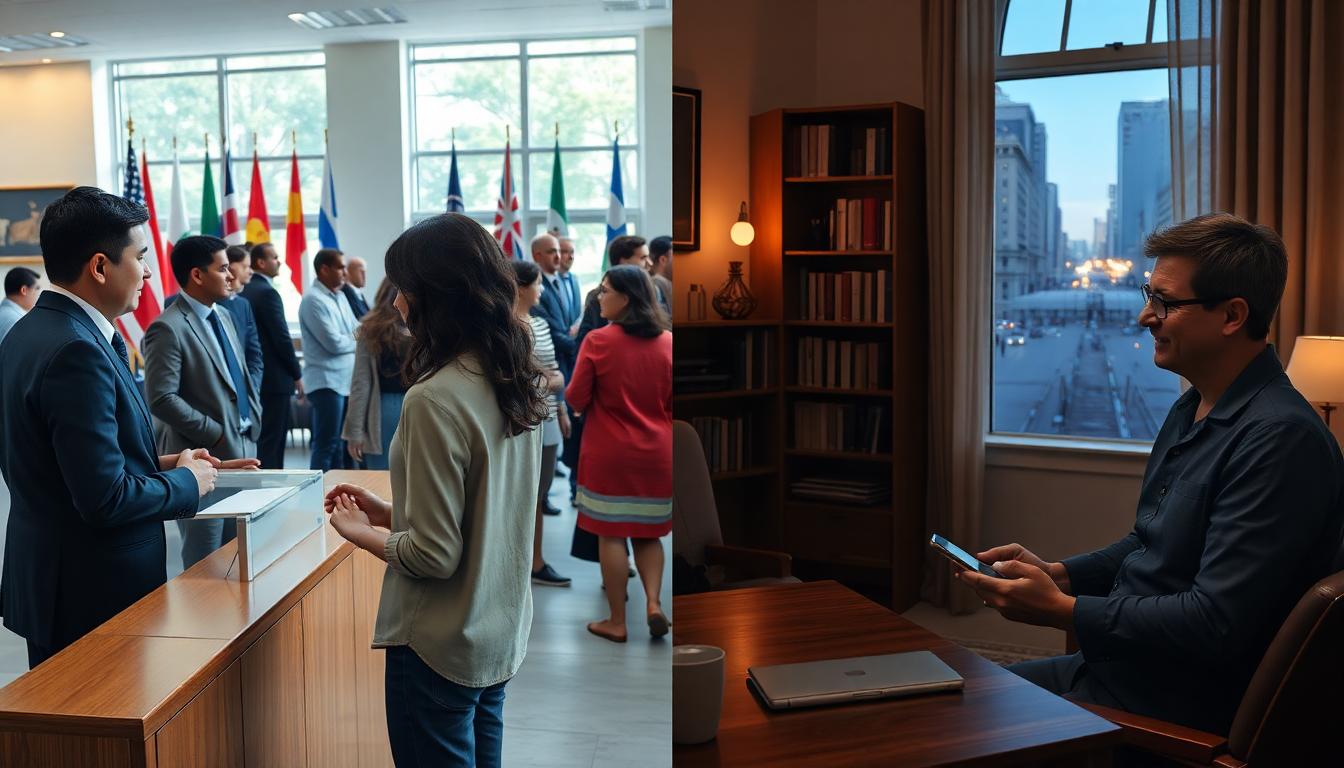 Location shapes the experience. Traditional consulates sit in city centers, with security gates and fixed hours. AI consulates live online, with no commute, and support that never sleeps. That shift changes who can get help, and when.
Staffing looks different too. Traditional offices rely on consular officers, local hires, and guards on site. AI consulates blend small expert teams with software that triages, checks files, and routes cases. Humans still provide ethical judgment for calls that affect rights, safety, or travel bans.
Access is the final split. Physical sites offer local ties, not always reach. AI services offer 24/7 access, not always a personal touch. The best setups use both. Software clears routine steps so officers can focus on human judgment calls.
What this means in practice:
- Location: Building with windows and queues, or phone with chat and uploads.
- Staff: Window officers and back office teams, or analysts backed by AI tools.
- Access: Appointments within office hours, or on-demand help at any hour.
The right fit depends on the task. Emergency travel papers might start online, then finish in person. A simple visa check might stay online from start to finish. Both models can work well when roles are clear.
Interaction Styles: In-Person vs. Online
Face-to-face talks feel human. People read tone, explain context, and build trust. Officers can spot stress, ask smarter follow-ups, and help calm a tough moment. The tradeoff is time, travel, and the chance of repeat visits.
App chats feel fast. Answers come in seconds. File checks run on upload. The chat remembers past messages and links to the right rule. The tradeoff is a screen, not a person, and limits on nuance.
Here is a clear contrast that helps readers weigh both paths:
- Speed: AI replies at once. In-person time depends on bookings and queues.
- Clarity: Online chats show links, checklists, and receipts. Windows rely on memory and notes.
- Empathy: Officers read the room. Software offers structure, not feelings.
- Proof: Apps log everything. In-person talks may need a follow-up email for records.
- Complexity: Edge cases often need a human. Routine cases move online with fewer stops.
A blended model helps. Start with the app to collect facts, validate images, and pre-fill forms. Book an officer when a judgment call, legal risk, or a minor needs care. People save time, and staff see cleaner files.
Practical examples make it clear:
- Lost passport abroad: start online for triage and a checklist, then visit for the document.
- Tourist visa questions: ask the app for fees, timing, and documents, then submit in minutes.
- Name mismatch on records: use chat to flag the issue, then schedule a targeted review.
Which feels more reliable to you? Some value a calm voice across the glass. Others trust a time-stamped chat and a clear trail. Both have value. The choice should match the risk, the deadline, and the traveler’s comfort.
Efficiency and Security: Pros and Cons Compared
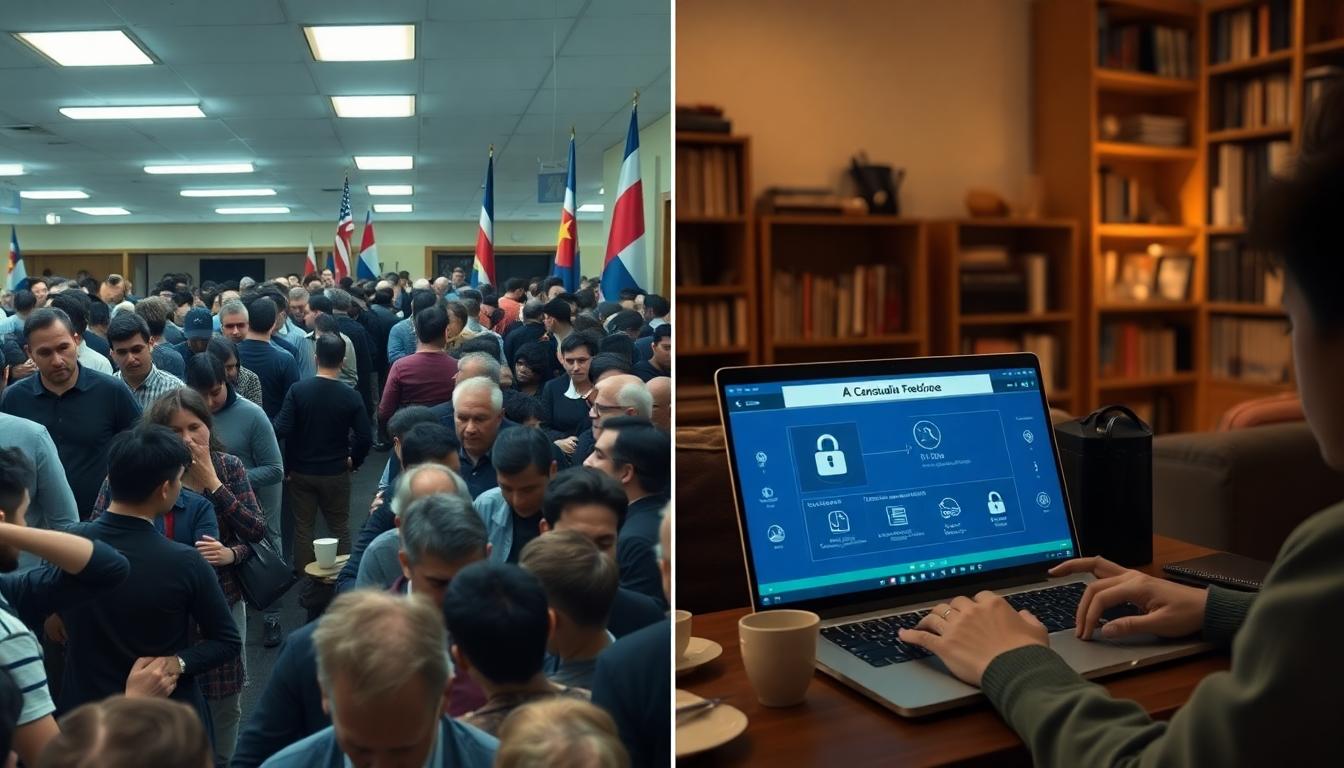 A split-scene shows a busy consulate waiting room vs. a secure AI session at home. Image created with AI.
Speed and safety often pull in different directions. AI consulates score high on speed and uptime. Traditional consulates score high on trust, human care, and data privacy. The right pick depends on the task, the risk, and the user’s comfort.
Here is a quick scan of trade-offs that matter on a busy day.
AreaAI consulateTraditional consulateSpeedInstant replies and checksAppointment wait, in-person paceAvailability24/7 access onlineOffice hours onlyAccuracyAuto checks reduce errorsHuman review catches contextSecurity exposureData on networks and devicesData on paper, in officesPrivacy controlLogs and consent screensFace-to-face, fewer digital trailsCost to scaleLow per case after setupStaff and space drive costHuman supportEscalates on edge casesDirect talk at the window
Both can be safe and fast. Process design, including regulatory compliance, makes the difference. Good controls shrink risk without slowing service.
Handling Risks in Each System
 Photo by cottonbro studio
AI consulates face cyber threats. Attackers go after accounts, data, and models. Common risks include:
- Phishing and account takeover: fake emails and sites steal logins.
- Weak passwords and reused creds: one breach unlocks many accounts.
- Data leaks: poor data handling in misconfigured storage or sloppy sharing.
- Prompt injection: bad inputs try to twist AI responses, requiring bias mitigation to prevent unintended biases or manipulations.
- Supply chain risk: third-party tools with hidden flaws.
- DDoS attacks: floods that knock services offline.
Simple fixes stop most of the pain:
- Use a password manager and strong passwords. Add multi-factor on every account.
- Update phones and laptops. Patch routers and browsers.
- Turn on device encryption with cryptographic security. Lock screens with PIN or biometric.
- Check sender and URL before clicking. When unsure, visit the site direct.
- Limit staff access by role. Review access every quarter.
- Keep audit logs. Alert on odd logins and bulk downloads.
- Use rate limits and bot checks on forms.
- Back up configs and keys offline. Test restore steps. For advanced protection, leverage trusted execution environments for sensitive computations.
- Publish a clear status page. Share incident steps and updates fast. Resources like the Responsible AI Institute can guide the development of good controls, including ethical frameworks for bias and policy.
Traditional consulates face physical and process risks. Lines and paper create weak spots:
- Long queues: stress, crowding, and missed slots.
- Privacy leaks at windows: voices carry, papers show.
- Paper loss: forms misfiled or left on desks.
- Bribery and “fixers”: off-site agents who sell fake speed.
- Health risks: packed rooms, poor airflow.
- Theft and scams outside: passports and bags targeted.
Practical fixes ease pressure and protect people:
- Timed appointments with SMS tickets. Stagger entries.
- Clear signs and staff at the door. Short triage lane for emergencies.
- Privacy screens at windows. Numbered slips, not names, on displays.
- Cashless payments. Receipts by email or print on demand.
- Lockable drop boxes for documents. Barcode every file.
- Shade, seating, and water in waiting areas.
- Secure perimeter with cameras in public zones. None at the window line.
- Report channels for abuse and scams. Post them on doors and receipts.
A blended model works best. Let AI handle forms, checks, and tracking. Let offices handle identity, judgment, and edge cases. Users get speed without giving up safety. Staff get clean files and fewer bottlenecks.
Real-World Examples and Future Outlook
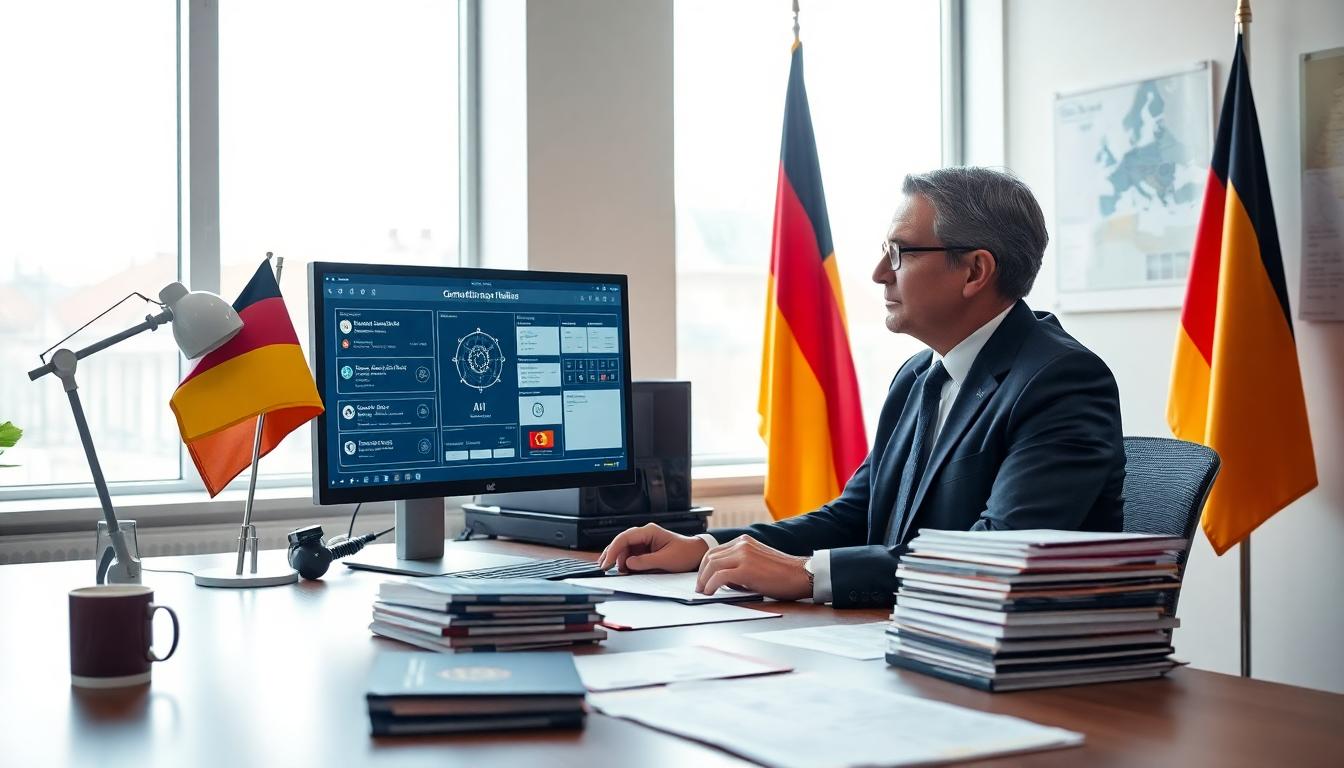 AI in consular work is not theory. Governments already use AI to process forms, scan documents, and route cases. The pattern is clear. Early leaders, influenced by groups like the AI Embassy Foundation, mix strong policy with pilot projects, then scale what works into sovereign AI infrastructure. Travelers feel the change first through faster answers, clean checklists, and fewer return visits.
What Countries Are Leading the Change?
Germany stands out. Its missions test AI for document checks, intake triage, and status updates. Officers still make the call, but the system does the heavy lifting upfront, reducing the administrative burden on staff. That means cleaner files, fewer errors, and shorter queues. For a traveler, it shows up as instant feedback, clear next steps, and fewer surprises.
Why Germany’s approach resonates with users:
- Fast pre-checks: AI flags missing pages, bad photos, or wrong formats.
- Smart routing: Cases reach the right desk without guesswork.
- Transparent status: Applicants track progress with time stamps and alerts.
Other governments are moving fast too, each with a useful angle that benefits users.
- United Arab Emirates: Pilots 24/7 AI support in missions. Citizens get instant help for common needs, which cuts wait time and stress.
- Saudi Arabia: Builds legal grounds for AI embassies. That supports secure digital consular work and protects records, which boosts trust.
- Estonia: Hosts government data abroad under national law to maintain digital sovereignty. This keeps services online during outages, which helps during crises.
- Israel: Invests in AI for migration and work permits. Expect faster risk checks and fewer manual steps.
- Japan: Explores AI to streamline visa handling. Document review and scheduling speed up, which reduces bottlenecks.
What this means for people who need help:
- Faster first answers on fees, timing, and documents.
- Fewer form errors, since AI checks happen on upload.
- Clear audit trails that reduce back-and-forth emails.
- Better uptime during storms, holidays, or local closures.
Short-term outlook:
- More hybrid models. Start online, finish in person when needed.
- Wider use of secure data hosting, like data embassies.
- Standardized file rules across missions, which reduces guesswork.
Medium-term outlook:
- AI pre-screens most routine cases. Officers handle edge cases and risk.
- Real-time policy updates based on data-driven decisions inside chat guides. Fewer surprises for travelers.
- Cross-border status sync, so users see one timeline across agencies.
The bottom line for users is simple. Services feel faster, clearer, and more predictable. AI handles the grind. People get quicker outcomes with fewer trips. Officers have more time for cases that truly need a human call.
Conclusion
AI Consulates excel at quick triage, clean forms, and round-the-clock consular services. Traditional consulates excel at identity checks, legal calls, and care in tough moments.
Use AI for first answers, document checks, tracking, and simple visa needs. Go in person for emergencies, crisis management, minors, name or status conflicts, prior refusals, or any high-risk case.
Expect more hybrid service ahead, with software upfront and officers for human judgment. Share thoughts in the comments, and note what worked best in real trips.
